The Publisher learned of this speech by reading the book, Congress at War, by Fergus W. Bordewich.
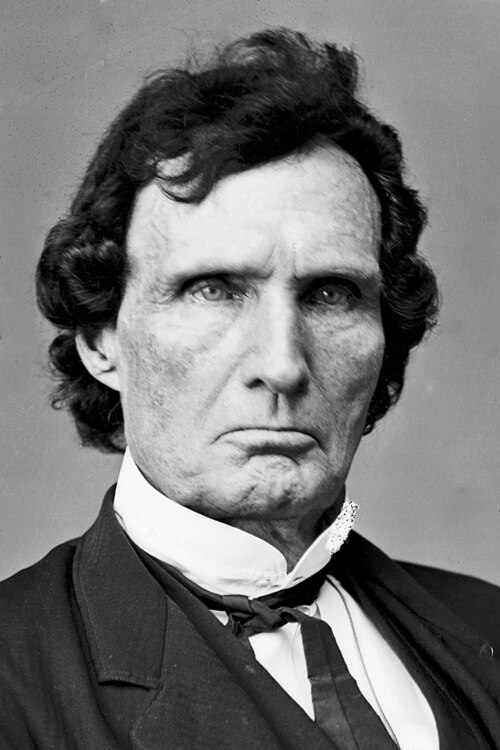 |
| Congressman
Thaddeus Stevens of Pennsylvania |
STATE OF
THE UNION
SPEECH
OF THE
HON.
THADDEUS
STEVENS,
OF PENNSYLVANIA.
DELIVERED
IN THE HOUSE OF REPRESENTATIVES, JANUARY 29,
1861.
| Thaddeus
Stevens (1792--1868) was one of the most important Congressmen of the
Civil War period. Born into poverty in Vermont, he nonetheless
was graduated from Dartmouth in 1814, and began to read law with a
Vermont attorney. In early 1815, following a friend, he moved to
York, Pennsylvania to teach at the York Academy and continue to read
law. After a moderately successful legal career, he entered
politics, first as an (extreme) anti-slavery Whig, then as a
Republican. He spent two stints in Congress (1849--1853),
representing Pennsylvania's 8th Congressional District (then the area
around Lancaster); and then (1859--1868) the 9th Congressional District
(the area around Gettysburg, where he first lived upon moving to
Pennsylvania). During the Civil War, Stevens advocated for
emacipation and harsh recobstruction, including expansive rights for
the freedmen. The Publisher learned of this speech by reading the book, Congress at War, by Fergus W. Bordewich. |
|
The
House then resumed the
consideration of the special order, being the report of the special
committee
of thirty-three. Mr.
STEVENS, of Pennsylvania. I do not expect
to be heard in all parts of
the Hall, owing to the bad state of my health and voice; but I will
present some
views on the pending question, which I may not have another opportunity
to do. I
regret, sir, that I am
compelled to concur in the belief stated yesterday by the gentleman
from
Virginia, [Mr. PRYOR,] that no compromise which can be made will have
any
effect in averting the present difficulty. I
concur in that belief, because it is my belief, although
I regret the
fact; for when I see these States in open and declared rebellion
against the
Union, seizing upon her public forts and arsenals, and robbing her of
millions
of the public property; when I see the batteries of seceding States
blockading
the highway of the nation, and their armies in battle array against the
flag of
the Union; when I see, sir, our flag insulted, and that insult
submitted to, I
have no hope that concession, humiliation, and compromise, can have any
effect
whatever. And what confirms me—if
confirmation were necessary—and what confirms the remark of the
gentleman from
Virginia, [Mr. PRYOR,] is a piece of news contained in the paper just
laid upon
the desks of members. Virginia sends
ambassadors
to the head and front of the empire that is proposed to be erected upon
the
ruins of this Government, for the purpose of getting South Carolina to
appoint
commissioners for the purpose of proposing amendments to the
Constitution of
the United States, to secure their rights, as they say; and that
kingdom of
South Carolina peremptorily refuses to appoint any such commissioners,
for the
reason that it has no desire or design of promoting the ultimate object
set
forth in the joint resolutions of the State of Virginia—that is, the
procurement of amendments to, or new guarantees in, the Constitution of
the
United States. Thus ends negotiation;
thus ends concession; thus ends compromise, by the solemn declaration
of the
seceding party that they will not listen to concession or compromise. Mr.
Speaker, following close upon
the belligerent speech of the gentleman from Virginia yesterday, I saw
the
contribution toward compromise which the slaveholding States are
willing to
make to the North—for compromise means some concession from both sides. Immediately after that speech a bill came up
to admit Kansas into the Union; and I am sorry to say that almost every
southern man—men
who had just been appealing to us to furnish them ground to stand
upon—almost
in a solid body the southern men voted against even the consideration
of the
question of admitting Kansas, that source of all our woes.
I leave the inference to the country. I
have no expectation that
anything that we could say or do, or that could be said or done, in
Congress,
would have the least effect in retarding or accelerating the onward
career of
the secession movement which already pervades this land.
I do not believe that words now will have any
effect; yet it is right that the effort should be made.
It is right that upon this floor we should
enunciate our views; that from this Hall, sacred to freedom and free
debate, we
should inform our constituents of the condition of things, that they
may well
consider them;
so that, if we are wrong, they may correct us; and if we are right,
they may
strengthen our hands. Sir,
I will touch but briefly
upon the question of secession which is claimed by the gentleman from
Virginia,
[Mr. PRYOR,] and upon the right of coercion, which is denied by him,
and the
kind of coercion which, in my judgment, will prove effectual to bring
them back
into this Union without humiliation, and make that Union permanent. I regret to be obliged to concur with the gentleman from Virginia, that no compromise can be offered that will avert the present evils. This morning’s papers contain conclusive confirmation of that in the resolutions of the leading seceding State, South Carolina, which are as follows: “Resolved
unanimously, That the General
Assembly of South Carolina tenders to the Legislature of Virginia their
acknowledgments of the friendly motives which inspired the mission
intrusted to
Hon. Judge Robertson, her commissioner. “Resolved unanimously, That candor, which is due to the long-continued sympathy and respect which has subsisted between Virginia and South Carolina, induces the Assembly to declare with frankness that they do not deem it advisable to initiate negotiations when they have no desire or intention to promote the ultimate object in view—that object which is declared in the resolution of the Virginia Legislature to be the procurement of amendments or new guarantees to the Constitution of the United States. “Resolved unanimously, That the separation of South Carolina from the Federal Union is final, and she has no further interest in the Constitution of the United States; and that the only appropriate negotiations between her and the Federal Government are as to their mutual relations as foreign States.” But
I have not heretofore
expected that any thing that has been done, or could be said or done
here,
could have any effect in retarding or accelerating the headlong career
of
treason and rebellion that now frighten the land. This
I deeply regret; as I should be willing
to go to the verge of principle to avert this catastrophe. The question of the dissolution
of the Union is a grave one, and should be approached without
excitement, or
passion, or fear. Difficulties have
surrounded all nations in their inception, in their progress to
greatness, and
in their stability. Much of their
success has depended on the ability and the firmness of the statesmen
who had
the management, of affairs in the days of their trouble.
The virtue most needed in times of peril is
courage, calm, unwavering courage, which no danger can appal, and which
will
not be excited to action by indignation or revenge. If
such statesmen, governed by
such qualities, should be found at the head of this nation when danger
comes,
there can be no fear for the result. The
Union will overcome all difficulties, and last through unnumbered ages
to bless
millions of happy freemen. Homilies upon
the Union, and jeremiads over its destruction, can be of no use, except
to
display fine rhetoric and pathetic eloquence. The
southern States will not be turned from their
deliberate and stern
purpose by soft words and touching lamentations. After
the extent to which they have gone, it
would do them no credit; condemnation which is now felt for their
conduct,
would degenerate into contempt. The
annual message of the
President contains some wholesome truths mixed with atrocious calumnies. It states that一 “The
long continued and
intemperate interference of the northern people with the question of
slavery in
the southern States has at length produced its natural effects.” The
President well knew that the
anti-slavery party of the North never interfered, or claimed the right
to
interfere, or expressed a desire to intermeddle, with slavery in the
States. Search the proceedings of their
Legislatures,
their conventions, and their party creeds, and you will find them
always
disclaiming the right or the intention to touch slavery in the States
where it
existed. But this calumny on the freemen
of the North, so often repeated by a man who, during his whole
political life,
has been the slave of slavery, is not worth a moment’s consideration. He makes a very able and conclusive argument
against the right of secession; and had he followed it out to its
legitimate
results, he would have deserved the gratitude of his country. But after denouncing secession as
a great wrong, he came to the impotent conclusion that there is no
power in the
Government to prevent or punish it. It
is time that this important
question were solved. I do not perceive
when any better occasion can present itself to decide whether this
Union exists
by the sufferance of individual States, or whether it requires a
constitutional
majority to absolve them from their allegiance. If
it should be determined that secession is a rightful
act, or that
there is no power to prevent it, then the Union is not worth preserving
for a single day;
for whatever disposition shall be made of the present difficulty,
fancied
wrongs will constantly arise, and induce State after State to withdraw
from the
Confederacy. If, on the other hand, it
should it be decided that we are ONE PEOPLE,
and that the Government possesses sufficient
power to coerce obedience, the public mind will be quieted, plotters of
disunion will be regarded as traitors, and we shall long remain a
united and
happy people. It
did not require the present Constitution to make our
Union perpetual in theory. The
Articles of Confederation declared in express terms: “That
the Articles of
Confederation shall be inviolably observed by every State, and the
Union shall
be perpetual.” If
the force of moral suasion and
patriotism were alone to be relied on to insure its perpetuity, the
convention
which substituted the present for the old Constitution was but little
needed. True, there were other defects in
the old
Articles. The several States had
conflicting laws with regard to the revenue, taxation, and other
subjects. As Congress could operate only
on the States
if they refused to comply with their requisitions, it was difficult to
enforce
them. But the great defect in the
preceding Government was the want of authority; and the main motive for
the change
was to clothe the central Government with sufficient power to
perpetuate its
own existence. The resolutions of the
several States appointing delegates to the convention, and the act of
Congress
recommending it, show that. The act of
Congress of May, 1787, recommended a convention “so to alter the
Articles of
Confederation as shall be necessary to the preservation and support of
the
Union.” Massachusetts instructed her delegates so to amend as to render
the
Federal Constitution “adequate to the preservation of the Union.”
Connecticut
instructed hers in the same words. New
York instructed, so to amend as to render the Federal Government
“adequate to
the exigencies of Government and the preservation of the Union.” As
to coercion, General
Washington, in a letter to Mr. Madison, dated before the convention,
(March 31,
1787,) in discussing the necessity for a stronger Federal Government,
says: “I
confess, however, that my
opinion of public virtue is so far changed that I have my doubts
whether any
system without the means of coercion in the sovereign, will enforce due
obedience to the requirements of the General Government; without which
everything
else fails.” These quotations might be
fortified by similar ones from many States and leading statesmen. They prove, beyond all doubt, that the
Constitution was intended and supposed to confer on the Government
sufficient
power to defend and perpetuate the Union; if necessary, to “coerce” a
rebel
State, or, to reach the same point by a surer road, to coerce the
people of the
State to obey all laws of the General Government. The
Congress of the Confederation
could act only on States. If they were
refractory, it was found difficult to enforce the laws.
The Constitution is made to operate directly
on the individuals—on the people, without resorting to State
authorities or
asking State aid. The Constitution being
ordained by the people, and operating directly on them, does not permit
the
States to thwart its operations any more than it invokes their aid. It is a self-sustaining, independent power,
and absolutely sovereign within its sphere. If
a State pass laws or ordinances hostile to the
Constitution, no
citizen is bound to obey them. Nay, he
is bound not to obey them. If, in
obedience to them, he violates the Constitution, he cannot plead such
laws in
his defense. It behooves every citizen,
at his peril, to decide whether he will obey the higher or the lower
power—the
Constitution of the United States or the void enactment of States. If he commit treason against the United
States, he will not be excused, like a soldier who obeys his commander,
on the
ground of obedience to higher authority. In order to clothe the central
Government with power to defend the Union and make it perpetual, the
Constitution provides that— “Congress
shall have power to lay
and collect taxes, duties, imposts, and excises, to provide for the
common
defense and general welfare of the United States; to regulate commerce;
to
declare war, and make peace; to raise and support armies; to provide
and
maintain a navy; to call out the militia; to suppress insurrection,'”
&c. It provides that the President
shall take care that all the laws shall be faithfully executed; and to
enable
him to do it, makes him commander-in-chief of the Army and Navy. To leave nothing in doubt, it gives Congress
power to make all laws which shall be necessary and proper for carrying
into
execution all powers vested by this Constitution in the Government of
the
United States. After these ample pro
visions, giving Army and Navy, revenue, and power for all needful
legislation,
it seems strange to hear that a great wrong may be committed against
the
Constitution, and no power exist to prevent or punish it.
Posterity will wonder whether the statesmen
of this age were fools or traitors. To
take away all power from the States to weaken or resist the General
Government,
the Constitution declares that “no State shall enter into any treaty,
alliance,
or confederation; grant letters of marque or reprisal; coin money or
emit bills
of credit;” it deprives them of all hope of foreign succor, of all
means of
raising funds by coining money or emitting bills of credit. Such obligations would be as worthless as
waste paper. The
Constitution wisely deprives
rebellious States of the means of doing harm. In
the Union, and with the Union, they are powerful; out
of it, and
against it, they are contemptible. They
may not be conscious of their weakness until they arise from their
fever and
find themselves staggering. Bui, in all
their movements, they will find the strong arm of the Constitution
reach and
control them. No respectable authority
can be found to show the right of secession. All
our great statesmen, Washington, Madison, Jefferson,
Adams, Jackson,
Webster, Clay, and Buchanan, agree that the Constitution is a bond of
perfect
and perpetual Union; and that no power exists in the Constitution to
absolve a
State or individual from allegiance to the General Government. The only way in which a State can withdraw
from the Union—in other words, destroy it―is by an amendment to the
Constitution, or by revolution. It is
not likely that three fourths of the States will so amend the
Constitution as
to allow any State to break up the Government at pleasure.
The road by revolution lies through a sea of
blood, and nothing can justify it but intolerable oppression. That is never likely to be practiced by a
republican Government. The pretexts used to justify the
present movement are very unimportant; some of them ridiculous. It is said that people in the North have
violated
compacts in the Constitution. Bad men
exist
in all sections. It is impossible to
form any system of government perfect enough to prevent all crime. The northern States arc no exception; but I
believe there arc but few instances in which citizens of the South have
just
cause of complaint against the North. They
visit our States and cities, whether in pursuit of business or
pleasure, with perfect
safety. Her orators deliver lectures and
speeches in which they propagate the doctrines of slavery, not only
with
impunity, but they are listened to with respect and silence. They exercise entire liberty of speech,
without being molested either by officer or mob. I
believe they chiefly complain
of the non-execution of the fugitive slave law. There
have been a few instances of resistance to that law
by ardent individuals; but I
know of no instance in which punishment has not followed the offense. Whenever suit has been brought, juries have
given full damages in their verdicts. Where
indictments have been presented, upon just grounds, conviction and
sentence and
punishment have followed. This is all
that a just people would require. They
cannot expect to make us love slavery, or withhold the utterance of our
just
abhorrence of it. They cannot hope to
make the honest masses of the people adopt the blasphemy of some of
their
clergymen, and call it a divine institution. They
have too much respect for their temporal character,
and their
eternal salvation. if recrimination were
advisable, I think the list of grievances by southern men against
northern
citizens would be much more formidable. For
twenty years past it has been unsafe for northern men to travel or
settle in
the South, unless they would avow their belief that slavery was a good
institution. Every day brings news of
unoffending citizens being seized, mobbed, tarred and feathered, and
hanged by scores,
without any trial by legal tribunals, or evidence of guilt. Mr. RUST. I
did not hear the gentleman distinctly. If
I understood him, he said that for many
years it was not safe for northern men to go into the southern States. Mr.
STEVENS, of Pennsylvania, That has been my statement. Mr.
RUST. On what
facts is it predicated? Mr.
STEVENS, of Pennsylvania. On the facts of
the hangings. burnings, tarrings and
featherings that
northern men have been subjected to in the South. Mr. RUST. I
think the gentleman said a moment ago that
they were hanged by scores. I never
witnessed or heard of one being hanged in my State. Mr.
STEVENS, of Pennsylvania. I do not speak
of any particular locality. Mr.
RUST. There are a good many, however, who
deserve
hanging. Mr.
STEVENS, of Pennsylvania. I know that
there were four Methodist
preachers hanged last year in one State. I
see it stated also that, in the State of Maryland, a
meeting of
citizens recently gave warning to twelve men, who voted for Lincoln, to
leave
the place—all except one, whom they thought to be an out and out,
incorrigible
Republican; and him they kept to see whether they would hang him or hot. Mr.
KUNKEL. The gentleman refers to an
incident which
occurred in my own county. Mr.
STEVENS, of Pennsylvania. I have seen it
in the papers. Mr. KUNKEL. The
incident which the gentleman refers to is
said to have taken place within eight miles of my residence. I should like to see the authority for that
statement. To my knowledge, no such
thing ever occurred, although I live within eight miles of the locality. Mr.
WINSLOW. Oh, if the gentleman saw it in
the
newspapers, of course it must be true. The
newspapers cannot lie. Mr.
HARRIS, of Virginia. Will the gentleman
allow me to interrupt him
for a moment? I want to ask him one
question. I understood him to say that
the people of the South hung northern men by scores.
In behalf of Virginia I wish to say that her
people never hung a northern man except John Brown and his friends; and
then
they hung, not by scores, but by law. Mr.
STEVENS, of Pennsylvania. You hung them
exactly right, sir. Mr.
HARRIS, of Virginia. Yes;
they were well hung. Mr.
STEVENS, of Pennsylvania. They were hung
after trial by jury for a
crime for which they deserved death. Mr.
MAYNARD. Will the gentleman from
Pennsylvania allow me
to say a word here, as he seems to be passing from the topic of the
unkind
treatment of northern persons in the southern States.
I should be very unjust, and very ungrateful
to the people among whom I have lived now for a quarter of a century,
if I were
to sit by and hear these general remarks pass uncontradicted. It is a fact known to every one who lives
there, that the South is full of men of northern birth.
It is known that such persons are well and
kindly treated. It is known that many
southern firesides are graced with wives of northern birth. They also are honored, and are the mothers of
honored children. It
is true, however, that persons
from the North are sometimes roughly treated at the South; but in those
cases
their own conduct is general1y such as to bring this treatment upon
themselves. Let me give the gentleman a
single instance
of this kind, which occurred in my district. Mr.
STEVENS, of Pennsylvania. I am satisfied
with the gentleman’s word,
without any illustration. Mr. MAYNARD. I
can give the gentleman an example of a
young man in a law office, who so far forgot the proprieties of life as
to
assail, in opprobrious language, the virtue and reputation of the
female
portion of the community in which he lived. He
carried his conduct to such a degree of indiscretion
that he was at
last seized upon by a company of young men and—in common
parlance―ridden
on a rail, and driven from the place. He
has brought a suit for damages against those who so treated him. The suit has not yet been tried; but he will
doubtless recover such an amount of damages as the jury may think that,
under
the circumstances, he deserves. Never,
since Sancho Panza was tossed in the blanket, in any part of the world,
either
north or south, have men been permitted, with impunity, to outrage the
sentiments and feelings of communities into which they have obtruded
themselves
unbidden. It is one of the fundamental
laws of hospitality, that good manners alone insure to a stranger a
civil
treatment. Mr.
STEVENS, of Pennsylvania. I do not refer
to that sort of public opinion. I refer to
another topic altogether. Mr.
WEBSTER. I ask
the gentleman to allow me one minute. Mr.
STEVENS, of Pennsylvania. I do not like to
say “no;” but
my time is passing rapidly. Mr.
WEBSTER. Well,
sir, our districts run together for some distance, and as the gentleman
has
referred to what he says occurred in Chester Mr.
STEVENS, of Pennsylvania. I have stated
nothing that I do not know to
be facts. Mr.
WEBSTER. Well,
sir, the gentleman has inferred to certain events which he says
happened in my
district. Now, Mr. Speaker, I have Mr.
STEVENS, of Pennsylvania. If the object of
the gentleman be recrimination,
I cannot yield the floor for that purpose. Mr.
WEBSTER. Well,
sir, I desire only to refer to an occurrence which took place in
Carlisle,
Pennsylvania. A man from my State went Baltimore
county, in my district, to the gentleman’s State
to reclaim his slave who had escaped, and he was murdered at Christiana
while
endeavoring to effect the reclamation; and no man in either case was
ever
brought to justice for the act. Mr.
STEVENS, of Pennsylvania. I know something
about that myself; but I do
not see the necessity of bringing it in here. Mr.
WEBSTER. The gentleman should not make
charges against
the people of Maryland, if he does not expect a reply. Mr.
STEVENS, of Pennsylvania. I have not made
any charges that are not true. The fact to
which the gentleman now refers is
that a man from Maryland came into Pennsylvania to reclaim his slave,
and in
attempting to carry out that purpose, his own slave took his life. Mr.
WEBSTER. There was a great crowd of
persons aiding and
abetting. Mr.
STEVENS, of Pennsylvania. No, sir; there
were only two white persons
present, the rest were negroes. Mr.
WEBSTER. It was shown before the court,
that there was
a great crowd of white men and negroes, all together there. Mr.
JUNKIN. No, sir; no white man had any hand
in the
matter. Mr.
STEVENS, of Pennsylvania. The rights of
conscience and freedom of
speech are forbidden to northern men. They
are not allowed to receive or read documents which deny the justice of
slavery. A citizen of Virginia, at the
late election,
voted for the man of his choice, Mr. Lincoln, and was seized in broad
daylight,
in the midst of the respectable people of the place, his face blacked,
and he
expelled from his home. Sir, the South,
at this moment, is a hideous despotism, so far as northern citizens are
concerned. Their
courts are inaccessible to
secure redress. The slave trade is
openly justified. When a slaving pirate
is sent them for trial, with the fullest proof of guilt, the bills are
either
ignored or juries acquit. I
have omitted the real
aggression which one of the States frankly assigns as the reason of
secession. The North has taken from them
the power of
the Government, which they have held so long. According
to the strictest forms and principles of the
Constitution,
they have elected the man of their choice President of the United
States. No violence was used; no
malpractice is
charged; but the American people dared to disobey the commands of
slavery; and
this is proclaimed as just cause of secession and civil war. Sir, has it come to this? Cannot
the people of the United States choose
whom they please President? without
stirring up rebellion, and requiring humiliation, concessions, and
compromises
to appease the insurgents? Sir, I would
take no steps to propitiate such a feeling. Rather
than show repentance for the election of Mr.
Lincoln, with all
its consequences, I would see this Government crumble into a thousand
atoms. If I cannot be a fireman, let me
cease to
exist. The
committee of thirty-three
have shown their estimate of the magnitude of southern grievances by a
most
delicate piece of satire. As a cure for
their wrongs, and to seduce back rebellious States they offer to admit
as a
State about two hundred and fifty thousand square miles of volcanic
desert,
with less than a thousand white Anglo-Saxon inhabitants, and some forty
or
fifty thousand Indians, Mustees, and Mexicans, who do not ask
admission, and who
have shown their capacity for self-government by the infamous slave
code which
they have passed, which establishes the most cruel kind of black and
white
slavery. To be sure, the distinguished
chairman of that committee [Mr. CORWIN] seems to have become enamored
of
peonage. He looks upon it as a
benevolent institution, which saves the poor man’s cow to furnish milk
for his
children, by selling the father instead of the cow. Mr.
OTERO. Will the
gentleman allow.me to explain that peon law? Mr.
STEVENS, of Pennsylvania. Certainly; if it
does not come out of my
time. Mr.
OTERO. I have got
the law here. Mr.
STEVENS, of Pennsylvania. Ah, the
gentleman is going to make an
argument. Mr.
OTERO. Oh, no; I am only going to refer to
the law. I have here the law to which, I
presume, the
gentleman has reference. It is the one
which was attempted to be repealed by the bill of the gentleman from
Ohio [Mr. BINGHAM]
last session. Mr.
STEVENS, of Pennsylvania. The same one. Mr.
OTERO. I want to
have this portion of the law read. The
Clerk read, as follows: “No
court of this Territory shall
have jurisdiction, nor shall take cognizance of any cause for the
parental
correction that masters may give their servants for neglect of their
duties as
servants, for they are considered as domestic servants to their
masters, and
they should correct their neglects and faults; for as soldiers arc
punished by
their chief, without the intervention of the civil authority, by reason
of the
salary they enjoy, an equal right should be granted those persons who
pay their
money to be served in the protection of their property; Provided, that
such correction
shall not be inflicted in a cruel manner with clubs or stripes.” Mr.
STEVENS, of Pennsylvania. Oh, no; the
punishment, as I understand, is
to be inflicted with cat-o’-nine-tails. [Laughter.] Mr.
OTERO. I hope the gentleman will act
fairly in
presenting this case. Mr.
STEVENS, of Pennsylvania. There is a
clause in the law which provides
that anybody can take up a servant if he is found out after dark, and
have him
lashed thirty-nine times on the bare back. Mr.
OTERO. Is that in this law? Mr.
STEVENS, of Pennsylvania. Yes. Mr.
OTERO. The gentleman may read the entire
law, and he
will not find it. Mr.
STEVENS, of Pennsylvania. It is in the
laws of New Mexico. Mr.
OTERO. These are the laws of New Mexico. Mr.
STEVENS, of Pennsylvania. I do not know
whether that is in your
edition. Mr.
OTERO. I desire to make an explanation of
this
subject just here, and at this time. This
law is translated from the Spanish, it having been originally
introduced and
passed in that language. I want to read
now the Spanish version of it. [Laughter.]
I hope this matter will not be treated with levity.
The term in the original law is so different
in its significance, and so forcible, that it will even attract the
attention
of the gentleman himself, notwithstanding it is in the Spanish language. The translation of the act, as read, is
entirely incorrect. The word “correction”
should be qualified by the adjective “parental,” as it is in the
original
Spanish. The law would then read, that
no court in the Territory should have jurisdiction nor cognizance of
any cause
for the “parental correction” that a master may give to his servant. Now the word “correction” is not even the
term used in the original law, as passed by the Legislature. The terms used in the act are “reconvenciones
familiares” which do not even mean parental correction. The correct translation of these words is, “a
familiar or parental reprimand,” which everybody will admit is a very
mild
correction indeed. And again, the
proviso of the law positively forbids that such correction shall be
inflicted
in a cruel manner with clubs and stripes. Now,
they cannot be shut up in a room or deprived of food,
for that
would be considered cruel. All that the
law
says, when correctly translated, is, that “no court” shall have
jurisdiction,
nor shall take cognizance of any cause for the pa parental reprimand
that
masters may give their servants for neglect of their duties as servants. That is the correct translation, and such is
the meaning of the words “reconvenciones familiars.” Mr.
STEVENS, of Pennsylvania. Then I take it
for granted that slavery in
New Mexico means nothing more than parental admonition.
[Laughter.] The
secession and rebellion of
the South have been inculcated as a doctrine for twenty years past
among
slaveholding communities. At one time
the tariff was deemed a sufficient cause; then the exclusion of slavery
from
free Territories; then some violations of the fugitive slave law. Now the culminating cause is the election of
a President who does not believe in the benefits of slavery, or approve
of that
great missionary enterprise, the slave trade. The
truth is, all these things are mere pretenses. The
restless spirits of the South desire to
have a slave empire, and they use these things as excuses.
Some of them desire a more brilliant and
stronger government than a Republic. Their
domestic institutions, and the social inequality of their free people,
naturally prepare them for a monarchy surrounded by a lordly
nobility—for a
throne founded on the neck of labor. The
men now on the stage of
action must determine whether they have courage enough to maintain the
institutions which their fathers gave them. This
is a great responsibility,
but in my judgment not a difficult one. I
would certainly not advise the shedding of American blood, except as a
last
resort. If it should become necessary, I
see no difficulty, with the ordinary forces of the United States, to
dissipate
the rebels, whether of high or low degree. But
before a resort to arms, the
ordinary tribunals of the country should be tried.
There are laws against treason, misprision of
treason, murder, and sedition. Many
citizens will inquire, Dare we violate these laws? Dare we commit these
crimes?
Shall we not finally be overtaken by vengeance? I
do not say that a State can
commit treason. Corporations cannot be
hanged. But if a State pass treasonable
acts, and individuals attempt to execute them, and thus come in armed
collision
with the Government, they will be guilty of treason, and the State
enactments
will be no shield, for they will be nullities. I
am aware that the most guilty
would be the most likely to escape the proper punishment.
The legislators who decreed the conflict and
ordered the rebellion would not be apt to be present at the overt act. The civilians would be in council; the
soldiers in battle. The passing
seditious laws merely, and ordering others to execute them—although
moral
treason and misprision of treason—is not, in my judgment, treason. “Treason against the United States consists
only in levying war against them, or in adhering to their enemies,
giving them
aid and comfort.” In England, even after her great conservative act,
the
statute of treason, it was not necessary to be present at the overt
act, or so
near as to be able to give physical aid. Conspiring,
plotting, and counseling others to do the act,
although at a
distance, made them principals in treason; for by the common law, those
who
encouraged, advised, or contrived the act, or who gave aid to the felon
after
the act, were accessories in felonies; but as there could be no
accessories in
treason, the common law converted such as would have been accessories
in
felonies into principals in treason. But
we have no common law; and those only are traitors who potentially
committed
the overt act. Under our Constitution
there is neither constructive nor accessorial treason. I
am aware that a judge of the
district court of the United States in Pennsylvania laid down a di fie
rent
doctrine, in a charge to the grand jury. He
held that those abolition lecturers who incited slaves
to escape
would be guilty of any treason which anywhere was perpetrated by armed
resistance to the fugitive slave law. But
I think he said it in ignorance of the law. I
do not think that even the northern men who encourage
the South in
rebellion can be made criminally guilty of the treasonable conflict
which they
stimulate. I should regret to see the
respectable members of the late Union meeting in Philadelphia
(including a
learned judge of the supreme court) placed in that unpleasant position. But if it should be impossible, as it may be,
to execute the criminal laws in the midst of an infected population, I
think
there are other means that will prove effectual. South
Carolina (and when I speak
of South Carolina, I mean to include under that name all seceding
States, to
avoid prolixity, and thus what I might say of her shall apply to all
that have
seceded or may secede) has, with others, declared herself out of the
Union; and
no doubt fancies that she is so. What
ought to be done? Send no armies there to wage civil war, as alarmists
pretend. The General Government should
annul all
postal laws within her Territory, and stop the mails at the line of the
State. Who will suffer by that? For the
last year
the revenue derived from postage in South Carolina was $107,536; the
expense of
transportation $319,068; leaving a deficit of $311,532 to be paid by
the
Government. This saving could be borne
by the United States. How it will affect
South Carolina, her citizens will soon discover. There
are but a few other Federal
laws which it will be important to enforce. The
regulations of commerce and the collection of the
revenue by the
General Government is the strong arm which will hold the Union together
and
punish refractory members without bloodshed. The
revenue collected at Charleston for the last fiscal
year is $379,875.97;
the expense of collection was $70,542.97; leaving a net surplus of
$309,333. Let the revenue laws be
executed, and the
money paid into the Treasury; it will help to pay the expenses caused
by the refractory
member, and leave the new empire to direct taxation to support their
great
burden. How long the people will submit
to this cannot be told to a mathematical certainty.
Not long, I predict. But
it may be that this mixed
empire, consisting of a little over one third whites, and a little less
than
two thirds colored persons, may attempt to collect the revenue within
the district
of South Carolina. This, of course,
would be a direct violation of the Constitution, and would justify
armed
resistance. If the present Administration
had done its duty there would have been no necessity for shedding blood. Within the collection district of South
Carolina the Government had several formidable forts.
Had they been properly garrisoned and
supplied when it became evident that South Carolina would secede and
seize
them, they could have been impregnable. No
ships could enter the harbor of Charleston without the consent of those
who
held those forts. The revenues might have
been collected anywhere in the harbor or district.
If necessary, an armed vessel or two might
have been stationed there, and the revenue laws would have been easily
enforced. One
fort still remains to us
there, with less than one eighth of the proper garrison, or provisions,
or
munitions of war. I know it has been
suggested that
the President intentionally left those forts in a defenseless
condition, that South
Carolina might seize them before his successor had time to take means
for their
safety. I cannot bring myself to believe
it;
I will not believe it; for it would make Mr. Buchanan a more odious
traitor than
Benedict Arnold. Every drop of blood
that shall be shed in the conflict would sit heavy on his soul forever. The charge seems to receive some countenance
from the fact that but a handful of men are in the remaining fort,
without any
effectual attempt to reinforce them; while the rebels are inclosing
them with formidable
works, and openly declare the intention to take it.
An effort was made to send men and provisions
there, it is true. But our flag was
insulted, and the unarmed vessel driven off; and no effort has been
made to
avenge the insult. Tame, spiritless
Administration! Were the traitor Floyd still at the head of the War
Department,
we could understand it. It looks as if
those few soldiers were predestined victims. I
have full confidence that the gallant officer in command
will
successfully defend the stars and stripes, or gloriously descend, with
his last
soldier, to his gory bed. If they should
be sacrificed, how wretched must be the miserable man who permits it!
The fires
of remorse will forever burn in his bosom as fiercely as the infernal
fires of
Phlcgethon!
According
to my view, as our
operations in coercion will be by sea, blood need not be shed. If it should so, on the heads of the
malefactors let it rest. Will
South Carolina attempt to
build a fleet to drive off our Navy? She has neither money nor credit
to buy
one. Let us examine her capacity for
ship building. When high-swelling words
are used, it is well to look at the size of the animal that emits them. There have been such things as “mighty
voices, and nothing else.” I know that some small States have a large
capacity
for ship-building, like Tyre, Venice, Holland, or England.
In 1859 Maine built about forty thousand tons
of registered vessels. Even Vermont, who
from none of her highest mountains can see the ocean with a spy-glass,
built
for tonnage one hundred and nineteen tons. The
same year South Carolina built sixty-four tons! This
fleet, I learn
from the register, consisted of a small steamer and a canal boat! So of
the
other rebellious States. But she proposes to enter into
treaty stipulations with Europe, and, by granting free trade, attract
the
direct trade of commercial nations. But
she cannot do that without a direct violation of the Constitution. “No State shall enter into any treaty,
alliance,” &c. Although she may
disregard that provision, being in rebellion, yet no foreign nation,
being
warned that it is a violation of the supreme law of the nation, will
venture to
negotiate. Her ambassadors will not be
received in a single Court in Europe—it would be just cause of war. Nor can she negotiate with a State. The Constitution is careful to prohibit
treaties with foreign nations; and it adds: “Alliance or confederation.”
She could not confederate, even with the independent, free trading
island of
Manhattan. If
the revenue could not be thus
collected, and smuggling prevented, the Government should abolish all
laws
establishing ports of entry and collection districts within the
seceding
Slates, and prevent all vessels, foreign or domestic, from entering or
leaving
any of their ports. How will she send
her cotton and other surplus products abroad? She cannot load a vessel
in her
own harbors, for there are no national officers to give her a clearance. The vessel would be without papers, without
nationality, and a prize to the first captors. How
forlorn must be her condition! Without commerce,
without industry,
her seaports would be barren wastes. With
a flag recognized by no civilized nation; with no vessel entering her
ports,
except now and then a low black schooner scudding in from the river
Congo; with
no ally or sympathizer except the King of Dahomey. If
these States will have war,
who is to protect them against their own domestic foes? They now
tremble when a
madman and a score of followers invade them. If
a citizen declare his opposition to slavery, they hang
him; and
declare, as a justification, that it is necessary for their personal
safety;
because they say they are standing on the thin crust of a raging
volcano, which
the least jar will crack, and plunge them in. How,
then, will it withstand the booming of
cannon and the clash of arms? Sir,
the attempt of one or more
of these cotton States to force this Government to dissolve the Union
is absurd. Those who counsel the
Government to let them
go, and destroy the national Union, are preaching moral treason. I can understand such doctrine from those who
conscientiously dislike a partnership in slaveholding,—who desire to
see this
empire severed along the black line, so that they could live in a free
Republic. Let no slave State flatter itself
that it can dissolve the Union now and then reconstruct it on better
terms. The present Constitution was formed
in our
weakness. Some of its compromises were
odious, and have become more so by the unexpected increase of slaves,
who were
expected soon to run out. But now, in
our strength, the conscience of the North would not allow them to enter
into
such partnership with slaveholding. If
this Union should be dissolved, its reconstruction would embrace one
empire
wholly slaveholding, and one republic wholly free.
While we will religiously observe the present
compact, nor attempt to be absolved from it, yet if it should be torn
to pieces
by rebels, our next United States will contain no fool of ground on
which a
slave can tread, no breath of air which a slave can breathe. Then we can boast of liberty.
Then we can rise and expand to the full
stature of untrammeled freemen, and hope for God’s blessings. Then the bondmen who break' their chains will
find a city of refuge. Our neighboring
slave empire must consider how it will affect their peculiar
institution. They will be surrounded by
freedom, with the
civilized world scowling upon them. Much
as I dislike the
responsibility and reproach of slavery, I recoil from such a remedy. Let us be patient, faithful to all
constitutional engagements, and await the time of the Disposer of
events. Let us not destroy this grand
fabric of
freedom, which, when once dissolved, will never be rebuilt. Let there be no blood shed until the last
moment; but let no cowardly counsels unnerve the people; and then, at
last, if
needs be, let every one be ready to gird on his armor, and do his duty. Sir, I am reminded that this
is
not the language of Pennsylvania, as represented by the united voice of
her two
Senators. I know it is not. But I do not believe that
either of them
represented the principles of any considerable portion of the people of
that
State, While Pennsylvania would go, as I would, to the verge of the
Constitution and of her principles, to maintain peace, I believe it is
a libel
on the good name of her virtuous people, to say that she would
sacrifice her
principles to obtain the favor of rebels.
I believe it to be a libel on her manhood to say that she will purchase
peace by unprincipled concessions to insurgents with arms in their
hands. If I thought such was her character, I would
expatriate myself. I would leave the
land where I have spent my life from early manhood to declining age,
and would
seek some spot untainted by the coward breath of servility and
meanness.
To her pleasant valleys I would prefer the
rugged, bold State of my nativity; nay, any spot in the most barren
Arctic
regions, amid whose pure icicles dwells manly
freedom. |
Back to Causes of the Civil War (Main page) Back to Congressional Speeches and Correspondence Back to Chronology of the Fort Sumter Crisis Source: Congressional Globe, 36th Congress, 2nd Session, pp. 621--624; see also Fergus W. Bordewich, Congress at War, pp. 16--19. Date added to website: Sept. 24, 2025 |