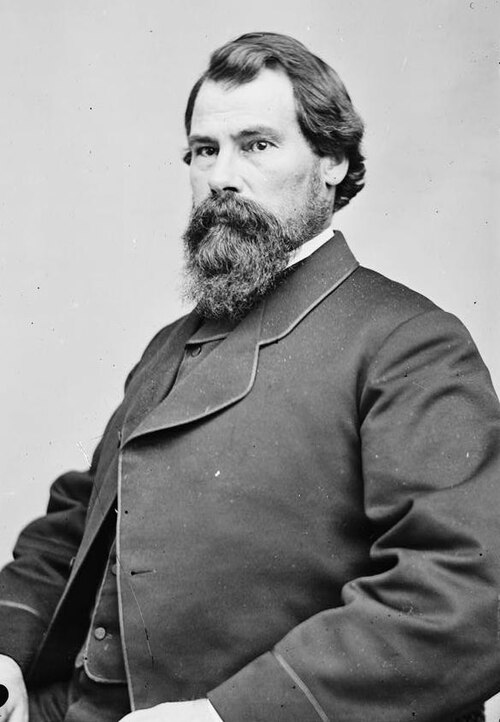
 |
| Congressman
John H. Reagan, of Trxas. |
Speech of Representative John H. Reagan of Texas, January 15, 1861
| Originally, only a very brief part of this speech was included here, taken from Kenneth Stampp's Causes of the Civil War, p. 89. (That part of the text is denoted here in dark gray.) The paragraphs before and after that part of the speech, rendered here in black, were taken from Reagan's postwar Memoirs and sent to me as raw text by Justin Sanders, a long-time friend of this website. In a sense, then, this speech is a conglomeration of the Congressional Globe version and the version given in Reagan's Memoirs. The main differences are minor changes in spelling and puncuation, and the omission of a few instances when Reagan was interrupted by others. The Publisher does think that what is presented here is a fair representation of Reagan's speech. Reagan became Postmaster General of the Confederacy, and after the war he returned to Congress (1875--1887) and then was elected to the Senate (1887--1891) He died on March 6, 1905. |
|
|
Mr.
REAGAN. Mr.
Chairman,
we stand in the presence of great events. When
Congress assembled some weeks ago, the control of the condition of the
country was in its hands. I came here
with a full knowledge of the deep discontent that prevailed in a
portion of the
States, and I felt then satisfied—as all must be satisfied now—that
they
intended to insist unconditionally and unalterably upon being secured
in their constitutional
rights in the Union, or on going out of it for the sake of
self-preservation. I came here with the
hope that such measures
might be brought forward by those who had the power to control this
question, as
would assure the people of the South that they might expect future
security for
their rights in the Union. I believe
that if the Republican members had manifested, at the beginning of this
session
of Congress, a purpose to respect simply the constitutional rights of
all the
States and of their people, all these difficulties might, before this
time, have
been settled. I do not mean to be
understood in making that remark as indicating that it would have been
necessary for them to have acceded to any extravagant or unreasonable
demands. Such demands would not have been
made, unless
they deem it extravagant and unreasonable to insist upon plain,
specific
guarantees of those rights which were assuredly secured to us under the
present
Constitution as it was formed, and which have been secured to us by the
action
of all departments of the Federal Government down to this time. This, I believe, was the condition of things
when Congress assembled at the beginning of this session.
In view of the fact that Republican members
of Congress have held sullenly back, and have neither proposed nor
accepted any
compromise, but have declared that they have none to make, four States
are now
out of the Union; and many others are in rapid motion to go out. Unless something can now he done to arrest
this movement, there will be but few southern States, if any,
acknowledging
allegiance to the Federal Government on the 4th of March next. This
state of things having been
produced, what can change it? I cannot say
now that it is possible to arrest the movement. It
is certainly all but impossible now to arrest it. It
is my duty to speak on this occasion as I
would speak in the presence of the future—as I would speak in the
presence of
the calamities invoked on this people by the action of this Congress,
and by a
portion of the States of the Union. No
men on the face of the earth, at any period of the world’s history were
ever charged
with a more solemn responsibility than that which rests to-day on the
American
Congress. It calls not for passion, but
for calm deliberation; not for the maintenance of mere partisan
supremacy, but for
the ascendency of patriotism; not for the domination of the one party
and the
overthrow of the other, but for a constitutional Union based on the
action of
the people, and on the support of a Government friendly to all its
parts; not
nurturing and fostering the one and hostile to the other, but just and
fair to
all alike. These are the great
principles which should animate our action if we intend to preserve the
Union. On the other hand, if fifteen
States come
here—minority as they may be in Congress, in the popular masses, in
wealth and
power—telling you of their discontents, and the cause of them, and if
you
tender no olive branch, no conciliation, but sternly deny them their
constitutional rights, and tender them on the one hand submission to
ruin, and
on the other powder and ball, who is it that does not know what their
decision
will be, whatever may be the consequences? Is
there a cause for this
discontent? It has been interrogatively
suggested
that there was none. It has been
partially admitted by others that there is some cause.
This is no time to come here and suppose
that, by special pleading and ingenious statements of the cause of
controversy,
we can change the judgment of posterity as to the attitude of public
affairs in
these times. It is beneath the dignity
of the statesman; it is beneath the dignity of the men who control
events to resort
now to special pleading to misrepresent the causes of the grievances
which now
exist. History will tell what those
causes are. All of you know to-day what
they are. For twenty years the
anti-slavery strength has been growing in the free States of this
Confederacy. In recent years it has become
aggressive. The question tendered to the
people of the
South is well expressed in the language of the President elect—that
this
agitation must go on until the northern mind shall rest in the belief
that
slavery is put in a condition of ultimate extinction.
That was his sentiment. That
is the sentiment of the great leaders of
that party. I presume that few members
of that party would to-day, in their place, deny that such was its
purpose. I take it for granted, that we
may act on the
presumption that that is its purpose. What
justice is there in that? Let us, for
one moment, revert to the history of the Government to know whether it
is just
in it to assume the responsibility of so grave an act.
I need hardly say that, at the date of the
Declaration of Independence, each of the thirteen colonies of the Union
was
slaveholding. At the date of the
formation of the Federal Constitution, twelve years after that, twelve
of the
thirteen States of the Union were slaveholding States.
Is it to be presumed that twelve out of
thirteen States made a Constitution which was intended to recognize
slaves as
freemen and equals? It
would be asking too much of
human credulity to believe such a proposition. If
anything were necessary to repel the idea, it is supplied by the bare
fact that the convention which framed this Constitution, and gave it to
us as
the charter of our rights and liberties, provided in it for keeping
open the
African slave-trade for twenty years after the formation of that
Constitution,
so that the white race might go on under authority of the Constitution
and
acquire a larger amount of property in negro slaves.
The interests of a portion of the States were
found not to require African slavery; and these States disposed of
their
negroes, not so numerous then, it is true, as they were in some of the
more
southern States. Then they made their
States what they call free States. The
southern States raised no objection, and had no right to raise any
objection,
that these States has chosen for themselves to exclude negro slavery;
but they
had rights under the Federal Constitution—the right to protection and
security—which
it was their duty to insist upon. That
is all they have done. But,
Mr. Chairman, I cannot dwell
longer upon this portion of our history; but I will ask attention to
another
feature of this question. I invoke the
attention of Republicans for a moment, to what would be the result of
the
success of their doctrines if they will not cease this agitation until
they can
rest in the belief that negro slavery is put in process of extinction. But, before I do it, I wish to make one
remark, not altogether connected with my argument; but which may not be
unserviceable. We have for years back
heard of what is
termed the irrepressible conflict. It
has emanated from men who have been eulogized for their statesmanship
and their
learning. It rested on the idea of
irrepressible
hostility between the interests and institutions of States of the Union. It has been invoked for partisan success and
for sectional prejudice. It has
culminated too soon for its authors. And
here, to-day, behold the fruits of the irrepressible conflict. Every man who looks forward with an eye to
the interests and hopes of the country, has foreseen what the
irrepressible
conflict meant—that it meant subjugation and humiliation to the South,
or the
dissolution of the Union. You have
reached now its logical end. Are you,
then, longer prepared to eulogize a doctrine, and eulogize its authors,
which
has brought upon us so precipitately such fruits as these?
But
to the point to which I was
calling attention. I ask Republicans
to-day—and
I would to God I could throw my voice to every city and town and
village and
hamlet in the whole North, and could be heard by every citizen there,
and
answered by all—to trace the history of the African race through all
the
centuries of the past, in every country and every clime, from their
native
barbarism in Africa to slavery in Brazil and the West Indies, and
everywhere
else that you find them, and then come to the Southern States, and
compare the
condition of the negroes there with their condition anywhere else, and
answer
me if they are not in the enjoyment of more peace, more blessings, and
everything that gives contentment and happiness, than any other portion
of that
race, bond or free, at any other age or in any other portion of the
world? Will any man deny that they are? And if they are, is it the part of
philanthropy
to turn them back to the condition of the rest of their race, and, in
doing so,
destroy the hopes and the social and political future of fifteen States
of this
Confederacy? Then, again, I would ask this
other question. Suppose these slaves
were liberated; suppose the people of the South would to-day
voluntarily
consent to surrender $3,000,000,000 of slave property, and send their
slaves at
their own expense into the free States, would you accept them as
freemen and citizens
in your States? [No! No! from the
Republican side of the House.] You dare not answer me that you would. You would fight us with all the energy and
power of your States for twenty years, before you would submit to it. And yet you demand of us to liberate them, to
surrender this $3,000,000,000 of slave property, to dissolve society,
to break
up social order, to ruin our commercial and political prospects for the
future,
and still to retain such an element among us. Again,
I ask you, do you believe,
one of you—does any Republican in this Union believe to-day that if you
could
purchase a separate Territory, occupied by no human being, if you could
liberate all the slaves to-day, take them to the Territory, frame a
government
for them, and give them money to start it—do you believe that, for one
year, or
any future period, those negroes could maintain a government in peace,
giving
security to life and person, and prosperity and repose to society? I venture to say there is not a Republican in
this Union who would hazard his reputation by answering that question
in the affirmative. And yet, in religion's
name, in God’s name,
in the name of justice and humanity, you are invoking every feeling
that can
stir the hearts of the people to press on with your irrepressible
conflict;
never halting, never stopping to consider, as all statesmen must
consider, the relative
condition and capacities of the races; and what is to be the end of the
conflict which you invoke, with the certainty, on your part, that it
must
result in breaking up this Republic, or in the subjugation and the
infliction
upon the South of the worst despotism that can be forced upon any
country. I address you with all the
earnestness of my nature;
I address you in the name of humanity, in the name of our common
country, and
of the cause of civil liberty. Again:
if I wanted experience to
prove the truth of my supposition that such would be the calamitous
effect of
carrying your principles to their ultimate results, the history of the
past
furnishes that experience. In 1793, when
red republicanism assumed its reign in France, and the wild delusion of
unrestrained liberty seized upon the minds of the masses, there was a
wretched
fanatic who undertook to proclaim the equality of every human being,
and they
proposed the liberation of the slaves in the French West India colonies. The idea chimed in with the popular delusions
of the day, and a decree was passed that all the slaves should be free. The colonies would not accept the decree, and
did not until the army of France was brought into requisition, and the
slaves
were set at liberty. But, what was the
result to the colonies? Great Britain,
catching
the contagion from France, determined upon the policy of liberating the
slaves
in her West India colonies; but she was a little more humane and
liberal. She did make compensation to the
owners of
the slaves liberated, to the amount of, perhaps, one-eighth of their
value. But what was the fruit of those
decrees to
the colonies interested? What was the
result of conferring the boon of freedom upon the African race in these
colonies? What was the condition of
these colonies prior to the execution of these decrees?
They were the homes of civilization, contentment,
prosperity, and happiness; their farms were cultivated, their cities
were alive
with business; their ports were covered with the canvass of the fleets
of all
nations, bearing to and fro the commerce of the world.
Those decrees were passed. What
followed? The white race was exterminated
by all the
implements and modes of cruelty and torture that ingenuity and
barbarism could
invent. Yes, sir, exterminated. The fields then glowing under the hand of
industry soon went back into jungle, inhabited by the wild beasts of
the
forest; grass grew in the streets of their cities, and ships departed
from
their ports to return no more. And they
have gone on in this experiment of liberty from revolution to
revolution,
carnage succeeding carnage, until at this time they have relapsed into
and
present a spectacle of savage African barbarism. Gentlemen
of the Republican party, are you
now prepared to go on in your aggressions until you have inaugurated
the same
scenes for your southern brethren? I say
your brethren, for hundreds and thousands of them are your common
kindred,
living in the enjoyment of the blessings of the same system of
Government, and
enjoying the prosperity common to our people. Are
you prepared to inaugurate a system which can only end in such a
result? Are you prepared to attempt to
force us by fire and sword to submit to such a fate as this? Your
people have lived in the
habitual violation of the Constitution and laws of Congress, for many
years, to
our serious injury, and we have never invoked the doctrine of Federal
coercion
against your States. Your Legislatures
have passed laws nullifying provisions of the Federal Constitution
which ought
to have secured protection to our rights. The
members of your Legislatures had to commit official perjury in
voting for these laws. And your
Governors had to do the same thing in signing and approving them. And a number of your States have passed laws
to fine and imprison their own citizens if they should aid in executing
the fugitive
slave law—a law passed in conformity with the requirements of the
Federal
Constitution, and which has been adjudged to be constitutional and
binding on
all by the Supreme Court of the United States. During all the time your States
have stood in open rebellion against the Constitution and laws of the
country—and
this in carrying out your aggressive and hostile policy against us—we
have
heard nothing of Federal coercion, not even from our northern friends
who are
now so ready to turn the Federal bayonets against us.
But now that the Southern States have
determined that they can stand these lawless and hostile aggressions on
their
rights no longer; now that they have determined not to live under a
Government
hostile to these rights, and that their safety and self-preservation
require of
them to resume the powers they had delegated to the Federal Government
for
their common good, but which are to be used under Republican rule for
their
ruin, we hear continually from Republicans of the treason and rebellion
of the
South; and they are loud and seemingly sincere in their demands for the
enforcement of the laws
by Federal guns. And I regret to see that
northern Democrats, some of them, seem to be
equally forgetful of our wrongs, and of abolition aggressions on our
rights,
and equally anxious for this gunpowder enforcement of the laws, against
the
authority of State sovereignty in the exercise of their highest and
most sacred
duties—the protection and defense of the rights of their own citizens
who can
no longer look for security or protection under a Government to be
administered
by hostile enemies under a violated Constitution. But
again: I wish to call your
attention to another point. What is to
be the effect upon the material prosperity, not of the South alone, but
upon
the North, upon Great Britain, and upon the whole of continental
Europe, from
the success of your policy? Let me ask
you to consider—for it would not seem that you have contemplated it for
yourselves—this fact: During the last year, the foreign exports from
the
southern States amounted to $250,000,000. Of
this amount, 200,000,000 consists in the exportation of the single
article of cotton. That cotton supplies
the
material for your northern manufacturers of cotton goods.
It employs the millions of capital engaged in
that business. It employs the time and
services of hundreds of thousands of operatives who work there. It employs the investments made in your
northern cities in the shipping in our coast-wise trade and foreign
commerce. It employs the untold millions
of English
capital engaged in the manufacture of cotton goods.
It employs the millions of English capital
engaged in the transportation of cotton, manufactured and
unmanufactured. It supplies with bread the
hundreds of
thousands of operatives employed in the manufacture of these goods in
England. Now
suppose you succeed in
striking down African slavery in the United States; you strike down not
only
our prosperity in the South, and inaugurate instead all the horrors of
Africanized barbarism under which the French and British West India
colonies
now suffer; you strike down all the investments made in the manufacture
of
cotton goods; you bankrupt your capitalists; you beggar your
operatives; you
bankrupt Great Britain; you beggar millions there; you inaugurate
starvation
and famine in Great Britain to an extent ten-fold beyond that which
will be suffered
here. You require of us unconditional
submission; and if that is not rendered, you propose to employ all the
force of
the Army and Navy to subjugate us. I
was going on to say that you
contemplate, as a part of the means of your operations, the blockade of
our
ports. Well, I grant that you have the
ships, and you could blockade our ports if none but ourselves were
concerned. But let me warn you in advance,
that like a
distinguished general of a former war, you will find a fire in the rear
as well
as in front when you undertake to do it. Your
own people will not permit you to do it. Your
commercial cities will not permit you to
do it. Your manufacturers will not
permit you to do it. But suppose your
people should be so demented as to allow you to destroy their
interests, do you
think Great Britain would permit it? Will
she permit you to bankrupt her capitalists engaged in the manufacture
of cotton
goods, and in the commerce growing out of cotton, and to starve her
millions of
operatives? If your own interests, and
all the dictates of humanity and justice, will not induce you to
forbear from
the madness and folly which must produce such results, Great Britain
and
continental Europe will promptly require you to raise the blockade of
our ports. Gentlemen,
I mention these
things, and you can consider them if you think they are worth
considering. We are dealing with questions
which involve
not only our interests, but the interests of all the civilized and
commercial
world. You are not content with the vast millions of tribute we pay you annually under the operation of our revenue law, our navigation laws, your fishing bounties, and by making your people our manufacturers, our merchants, our shippers. You are not satisfied with the vast tribute we pay you to build up your great cities, your railroads, your canals. You are not satisfied with the millions of tribute we have been paying you on account of the balance of exchange which you hold against us. You are not satisfied that we of the South are almost reduced to the condition of overseers for northern capitalists. You are not satisfied with all this; but you must wage a relentless crusade against our rights and institutions. And now you tender us the inhuman alternative of unconditional submission to Republican rule on abolition principles, and ultimately to free negro equality and a government of mongrels or a war of races on the one hand, and on the other secession and a bloody and desolating civil war, waged in an attempt by the Federal Government to reduce us to submission to these wrongs. It was the misfortune of Mexico and Central and South America, that they attempted to establish governments of mongrels, to enfranchise Indians and free negroes with all the rights of freemen, and invest them, so far as their numbers go, with the control of those governments. It was a failure there; it would be a failure here. It has given them an uninterrupted reign of revolutions and anarchy there; it would do the same thing here. Our own Government succeeded because none but the white race, who were capable of self-government, were enfranchised with the rights of freemen. The irrepressible conflict propounded by abolitionism has produced now its legitimate fruits-- disunion. Free negro equality, which is its ultimate object, would make us re-enact the scenes of revolution and anarchy we have so long witnessed and deplored in the American governments to the south of us. We do not intend that you shall reduce us to such a condition. But I can tell you what your folly and injustice will compel us to do. It will compel us to be free from your domination, and more self-reliant than we have been. It will compel us to assert and maintain our separate independence. It will compel us to manufacture for ourselves, to build up our own commerce, our own great cities, our own railroads and canals; and to use the tribute money we now pay you for these things for the support of a government which will be friendly to all our interests, hostile to none of them.
The
question again recurs, what
has brought about the perilous condition of the country? Why, sir, to
hear the
taunts that are made to the South; to hear the epithets of “treason,”
“rebellion,”
“revolt;” to hear the declarations and pretensions made in the North,
one would
think that the people of the South were a reckless, wayward people,
seeking
only to do wrong. How? In what? Let the question be echoed and
re-echoed all
over the Union—all over the civilized world. How? In what have the
South done
wrong? Have they sought to violate the Federal Constitution? Have they
sought
to violate the laws? Have they asked you to sacrifice any material
interest?
Have they asked you to sacrifice any principle that is not in conflict
with the
Federal Constitution and laws? I wish this question could go everywhere
and
sink into every heart, and be answered by every human being. How have
we done
wrong? In what have we wronged you? History is to answer the question;
and it
is to answer it in the face of the consequences which must follow. I
stand here to-day to say that
if there be a southern State, or a southern man even, who would demand,
as a
condition for remaining in this Union, anything beyond the clearly
specified
guarantees of the Constitution of the United States as they are, I do
not know
of it. I can speak for my own State. I think I have had intimate
association
enough with her people to declare that they have never dreamed of
asking more
than their constitutional rights. They are, however, unalterably
determined
never to submit to less than their constitutional rights. Never; never;
sir!
You can rely upon that, Mr. Chairman. Mr.
Chairman, I was going on to
say that we demand nothing but what were our clear constitutional
rights. We
will submit, sir, to nothing less. We ask no concessions as a mere
favor to us.
We demand our constitutional rights. That, sir, is the language of
freedom. We
demand them, and we intend to have them, in the Union or out of it. I
regret that in the course of
this discussion an assumption is made, and arguments are predicated
upon it,
that it was simply a question whether we have the right to rebel
against the
Federal Government. Those arguments have seemed to go upon the
hypothesis that
we neither knew nor appreciated the blessings of this Union; but, on
the
contrary, we hated and wished to destroy it. And here I must say that,
on
yesterday, I was deeply pained to hear certain arguments advanced by
the
distinguished gentlemen from Illinois and Ohio (Messrs. MCCLERNAND
and COX).
Their arguments seemed to proceed upon the assumption I have stated. I
was the
more pained, sir, because I have seen the gallant battles they have
fought
against the abolitionists and the “irrepressible conflict.” I know
their
experience, their judgment, and their capacity. I know, sir, that they
are
representative men of a great and gallant party. I felt profound regret
to see
such arguments, proceeding upon such an assumption, come from those
gentlemen. Now,
Mr. Chairman, if I can I
will correct some of the errors upon which the arguments advanced
against us
seem predicated. We do rightly estimate the value of the Union. We do
rightly
estimate the value of the blessings of this Government. We have loved
and
cherished the Union. Nobody has a better right than I have, although I
say so
myself, to make that declaration. I have loved the Union with an almost
extravagant devotion, I have fought its battles whenever they were to
be fought
in my section of the country. I have met every sectional issue, at home
in my
section, and in my State particularity, which was attempted to be
forced upon
the public mind, and which I thought would mar the harmony of the
Democratic
party. I have fought the battles of the Union without looking forward
to the
consequences. I have fought them in times when the result for the Union
seemed
hopeless. If I could believe we could have security for our rights
within the
Union, I would go home and fight the battles of the Union in the future
with
the same earnestness and energy that I have done in times past. While
those gentlemen tender us
war as the alternative, if we do not submit, yet, sir, not one word is
said in
the way of rebuke to those of the Republican party who have created the
present
storm; no demand is made of the Republican party to relinquish their
unconstitutional encroachments—to give up pretensions inconsistent with
our
system of government and our political rights. There, appeal ought to
be made,
that our rights should be given to us, and that we should be secured in
the
enjoyment of them. Let that be done, and no arm and no voice will be
raised
against the Federal Union. Deny us our rights, and we will face your
messengers
of death, and show you how freemen can die, or living, how they can
maintain
their rights. Mark that, sir! Where, Mr.
Chairman, is now our hope for conciliation? Pennsylvania and Vermont
have
already acted on the proposition to repeal their personal liberty
bills, and
they have refused to repeal those obnoxious and unconstitutional laws.
The
gentleman from Ohio (Mr. Cox) stated,
yesterday,
that he thought those laws would be repealed in Ohio. Mr.
HALE. There are no personal
liberty laws upon the statute-book of Pennsylvania. I know the
statement has
been made, but it has been corrected time and again. Mr.
REAGAN. I refer the gentleman
to his own statute-book. Mr.
MORRILL. Let me say a word
for Vermont. Mr.
REAGAN. I cannot allow myself
to be interrupted constantly. Mr.
MORRILL. I desire to correct
a statement that the gentleman has made. I know that he would not
willingly
misrepresent my State. Vermont, sir, has not refused to repeal her
personal
liberty bills. The matter was referred to a commission, and when that
commission reports, the Legislature will then, I have no doubt, act on
the
subject. Mr.
REAGAN. They have not
repealed the personal liberty bill. That was my statement; and that
statement
is not denied. I do not believe that they will repeal them in the
northern
States. It does not lie in the mouths of our northern friends to ask us
to believe
them until they can promise with certainty that those laws will be
repealed. We
know that delay is death. We have already experienced some of the
fruits of
delays. We
want to avert civil war if we
can. Yet no effort has been made to give us what, under the
Constitution, we
ought to have. It is not proposed to give us what will reasonably make
the
southern people believe that they will have security in the Union. No
such
proposition can be made and sustained; because, to give us our rights
is to
disband the Republican party. The existence of that party depends upon
violating the Federal Constitution; and in making war upon the
institutions of
the South. There is now an irrepressible conflict; and either the
Federal
Government or the Republican party must end. I am not here to palliate
or to
dodge one of the inevitable dangers that beset us. I am ready, for one,
to face
them all; and I think that that is the better course for us all to
pursue. When
we all do that, then we will have a just understanding of our relative
positions. You all know that we cannot, and dare not, live in this
Union, with
our rights denied by the Republican party, Its ascendency is our
destruction;
and, sir, its destruction this day is the only salvation for the Union. I
will now, for a moment, refer
to the arguments of the distinguished gentlemen from Illinois and Ohio
(Messrs.
MCCLERNAND
and Cox).
As one
member of this House, I want to give them an assurance that the
anticipations
they entertain, and upon which they base their arguments, can never be
realized. I have been taught, from my earliest instruction in the
theory and
practice of our Government, that this is a Government of consent and
agreement,
as contradistinguished from a Government of force or a military
despotism. It
is bound to be one or the other. Which is it? It is a voluntary
association of
free, republican States, upon terms of equality, or it is a military
despotism,
in which the Federal arm, through its army and navy, can subdue the
States at
will, and force them to submit to any grievance which may emanate from
the
Federal Government or other States? Which of these positions do my
friends
intend to assume? Assuming the principle that the Federal Government
has the
right to bind the States in all things, they go upon the hypothesis
that their
interests and position will require them to command the outlet to the
Gulf of
Mexico and the forts upon the coast of Florida. I do not rise for the
purpose
of denying the right of passage to the Gulf; but I must express my
regrets that
they talk in advance of cleaving their way to the Gulf by armies with
banners,
before one man from all that country has ever said that they should
have any
cause for war. No one has ever intended to deprive them of the benefit
of the
navigation of the Mississippi. No one intends it to-day; so that if we
are
trampled upon by force, let me proclaim to them and to the country,
that they
must place their action upon a different ground, because we intend that
they
shall never have cause of war upon that account. Mr.
McCLERNAND. The gentleman
seems to refer to my remarks of yesterday. Mr.
REAGAN. The gentleman did not
say so yesterday; but he did on a former day of the session. Mr. McCLERNAND. Never. A
Voice. It was said by the
gentleman from Ohio (Mr. VALLANDIGHAM). Mr.
REAGAN. All I want to say is
that our interest is peace, and our hopes are for peace. War is in
opposition
to all our interests and our hopes. We want no war; and we intend to
give no
just cause for war, unless the attempt to separate ourselves peaceably
from
despotism, and to take care of our rights under a friendly
government—and they
would be destroyed under a hostile government—is a cause for war. We
declare in
advance that we will not interfere with your navigation of the
Mississippi
river. We know that is necessary for you; but we cannot, because there
may
possibly be some conflict of interest between us, consent to surrender
our
liberties rather than assume the responsibility of organizing a
government
which will cover the lower part of that river and the capes of Florida.
The
gentleman from Illinois made
a statement yesterday, such as I suppose a gallant and heroic man would
make,
if his proposition was properly predicated. He said they could not
submit to
the control of the mouth of the Mississippi and the capes of Florida by
us;
that they would rather perish—perish, he said, with emphasis—than
submit to any
other power controlling the Mississippi, and commanding the coast of
Florida.
If such is the jealousy of the commercial rights only of his own
section; if he
feels so keen and sensitive a jealousy, what would he think of us if,
when our
commerce, our homes, our property, our social and political
possessions, for
all time to come, are imperiled, we should, like trembling dastards,
yield our
rights? A great heart like his would never expect it; would never exact
it. We
prefer liberty, and all its consequences, to a temporary peace without
honor;
and the gentleman will justify us if, under such circumstances, we tell
the
North, and tell the world that we accept independence, with all its
consequences, in preference to base submission, dishonor, and
irretrievable
ruin. We shall have no cause of war. My section sympathizes with the
gentleman
from Illinois and his friends. They look upon them as defenders of the
Constitution; and it has been my pride on many a stump and in many a
place, to
eulogize by name the gentleman from Illinois (Mr. MCCLERNAND)
and the gentleman from Ohio (Mr. Cox), with
all their
associates, for their gallant conduct, their moral courage, their
heroic
bearing, in standing up against northern fanaticism, and resisting its
onward
wave to the destruction of the Constitution, the Union, and our rights.
Now,
what will our people say when these speeches are printed and sent to
them, and
they see that these gentlemen are the first in this House who say that
the
assertion of our independence, when we can no longer live in this
Government,
shall invoke the cannon, the rifle, the sabre, and all the instruments
of war?
What will they say when they see that these gentlemen, who have long
resisted
abolitionism, defied its power, and been crushed down by its
operations, are
the very first to surrender at discretion in the face of the abolition
enemy? Mr.
McCLERNAND. I belong to a
particular association—a great party—that occupies a distinct ground in
this
controversy upon the slavery question. We have been a Union party—a
constitutional party—organized against the two extreme parties. We will
not
succumb to either, but continue to stand by the constitutional
guarantees, as
we have done in the past. Mr.
REAGAN. I would always have
expected from the gentleman such a proposition. I know the gentleman’s
position
well; and what I ask him to consider is, what has brought us to our
present
condition? If our rights had not been denied us—if our condition had
not been
imperiled—no voice would have been raised in the South for disunion.
Will you
compel us to submit to abolition behests? Will you demand that we shall
submit
to destruction at their hands? I understand the position of those
gentlemen;
but I ask them to review their words, and determine whether they are
prepared
to assert to the world and to the American people, that there is no
remedy
under this form of Government for the grievances, wrongs, and outrages
inflicted upon a State; that we shall, under this Government, have no
remedy;
and that it is in the discretion of the Federal Government to turn
against us
the cannon and the glittering sabre. Is such the Government under which
we
live? Is such the Government for which Washington and his compatriots
battled?
Is such the Government framed by Jefferson and Madison and their
associates?
No. It is a Government of consent, a Government of agreement, a
voluntary Confederation,
in which no power was conferred to use force against a State, in order
to
reduce her to subjection. In the convention which framed it, a
proposition of
such a character was offered and rejected by the convention; and by the
constitution itself, Congress can only exercise the powers specifically
delegated to it. I
have but one word more to say.
I live far to the South. We have a long Mexican boundary, and a long
Indian
frontier, infested by hostile savages throughout its whole extent; and
yet this
Government has refused for years to defend us against them. We have a
long
coast, open to the approach of a naval force, and we know the
consequences of
our acts, and we know what may follow an attempt to take care of
ourselves and
our liberty; but we remember, at the same time, the history of the
past. Less
than twenty-five years ago Texas stood a province of Mexico, with a
population
of not more than thirty thousand, entitled to the privileges of Mexican
citizens, including all ages and sexes. We lived under the Mexican
Constitution
of 1824, which the Texans fought to sustain. That Constitution was
subverted by
a military despot; and our liberties were trampled in the dust. That
despot
came against us with invading armies for our subjugation, He intended
to
overawe us by display of military power, as the President and General
Scott are
now attempting to do with the southern States. The thirty thousand
people of
Texas resisted that power for the sake of liberty and those rights to
which we
were entitled, trusting to the God of battles and to the justice of
their
cause. In that great struggle companies and battalions fell to rise no
more.
They sank nobly for freedom, as freemen will sink again for her cause
whenever
you shall tender to us that alternative. Upon the field of San Jacinto
they won
their liberty by their brave hearts and their stalwart arms. They
vindicated
that liberty for ten or twelve years after; and then as a pledge of
their love
to this Union, and their confidence in its principles, and desire for
its
prosperity and its happiness, that the people tendered Texas, a free
and
voluntary offering, to come in as one of the States of the Union, upon
terms of
equality with the other States. But
we were told yesterday that
we sold ourselves. The gentleman did not mean exactly what his language
would
imply; but he must see how offensive such kind of remarks must be to
those who
do not appreciate the use he intended to make of the argument. Texas
cost this
Government not one cent. She vindicated her liberty by her arms; and
rendered
to civil and religious liberty a country as large as the six New
England
States, and New York, Pennsylvania, Maryland, Ohio, and Indiana, all
put
together. She redeemed it from Catholic priestcraft, and military
despotism,
and has covered it over with five hundred thousand freemen, a
prosperous and
happy people; and they are prepared to vindicate their liberties when
they are
encroached upon again by a despotism of one or of many men. It
is true, that war grew out of
the annexation of Texas; and I suppose it is that which the gentleman
charges
Texas with. But this government knew what it was doing when it was
acquiring
dominion over that country, and adding to the United States to aid in
building
up its commercial, agricultural, and manufacturing interests. But they
also
acquired New Mexico and Utah, and the great golden State of California,
by that
war, and extended their power and dominion to the Pacific ocean. And
that it
was the gentleman from Ohio (Mr. Cox) and the
friends of those measures, now sneeringly refer
to in their reference to the purchase of Texas. I was sorry to hear it.
Allusion
has also been made to
the fact that $10,000,000 were subsequently paid for a portion of the
domain of
Texas, to some of which, it is said, she had no title. I have no time
to enter
into an argument upon that question. The Federal Government took up our
quarrel
for that boundary. As our agent, she obtained the title deed for us. No
lawyer
will say that it lay with her to dispute our title. She then offered us
$10,000,000 for a part of this land—eighty or a hundred thousand square
miles
of it. Texas accepted the offer. Shall the representatives of the
Federal
Government now taunt us with the statement that Texas has been bought
for a
price and paid for? Why, this government only bought a portion of
Texas. She
has that now. It is not in the jurisdiction of Texas. This Government
proposed
the trade. Texas assented to it. Was there anything in this to call for
contemptuous taunts? We made no sale to this Government of what is now
Texas.
But Texas did give to this Government, freely and voluntarily, her
sovereignty
and the dominion of all her vast and fertile domain, and ought to be
exempt
from the contemptuous charge of having been bought. It is wholly
untrue, and
self-respect should prevent the making of such a charge. Mr.
Chairman, there are other
subjects which I had hoped to discuss this morning, but I will not
trespass on
the patience of the House by discussing them now. I have to say in the
end,
that yet, almost hopeless as it seems, I would be glad to see an effort
made
toward conciliation. Above all things I stand here to invoke members to
look
upon this question as one which involves the interests and destiny of
States,
to warn them that they are making advances against fifteen States, with
thirteen million people, and with more than two-thirds of the exports
of the
country; against a people who understand all these questions, and who
are not
to be misled or deceived by special pleading; a people who never
intended or
wished to raise their voice against the Federal Government, and who
never would
have done so if they had been let alone. Remember that we only ask you
to let
us alone—nothing else. Give us security in the Union. Respect our
rights in the
common Territories. So act among yourselves as to let us know that we
need no
longer live under continual fear of the consequences of your action. I must say that the very State
from which I came, the very district which I represent, has had some
painful
experience during the last summer, growing out of the doctrines of
abolitionism. We found, for the last two or three years, that the
members of the
Methodist Church North, and others, living in Texas, were propagating
abolition
doctrines there. We warned them not to carry on their schemes of
producing
disaffection among our negroes; but they persisted, and did not cease
until
they had organized a society called the Mystic Red. Under its auspices,
the
night before the last August election the towns were to be burned and
the
people murdered. There now lie in ashes near a dozen towns and villages
in my
district. Four of them were county seats, and two of them the best
towns in the
district. The poisonings were only arrested by information which came
to light
before the plan could be carried into execution. The citizens were
forced to
stand guard for months, so that no man could have passed through the
towns
between dark and daylight without making himself known. A portion of
them paid
the penalty of their crimes. Others were driven out of the country.
These
things had their effect on the public mind. They were the results of
abolition
teachings; a part of the irrepressible conflict; a part of the
legitimate
fruits of Republicanism. |
Back to Causes of the Civil War (Main page) Back to Congressional Speeches and Commentary Sources: Kenneth Stampp, The Causes of the Civil War, p. 89; John H. Reagan, Memoirs, pp. 254--270; Congressional Globe, Second Session, Thirty-Sixth Congress, pp. 389--393. Date originally added to website: June, 1998. Updated: August 23, 2026. |