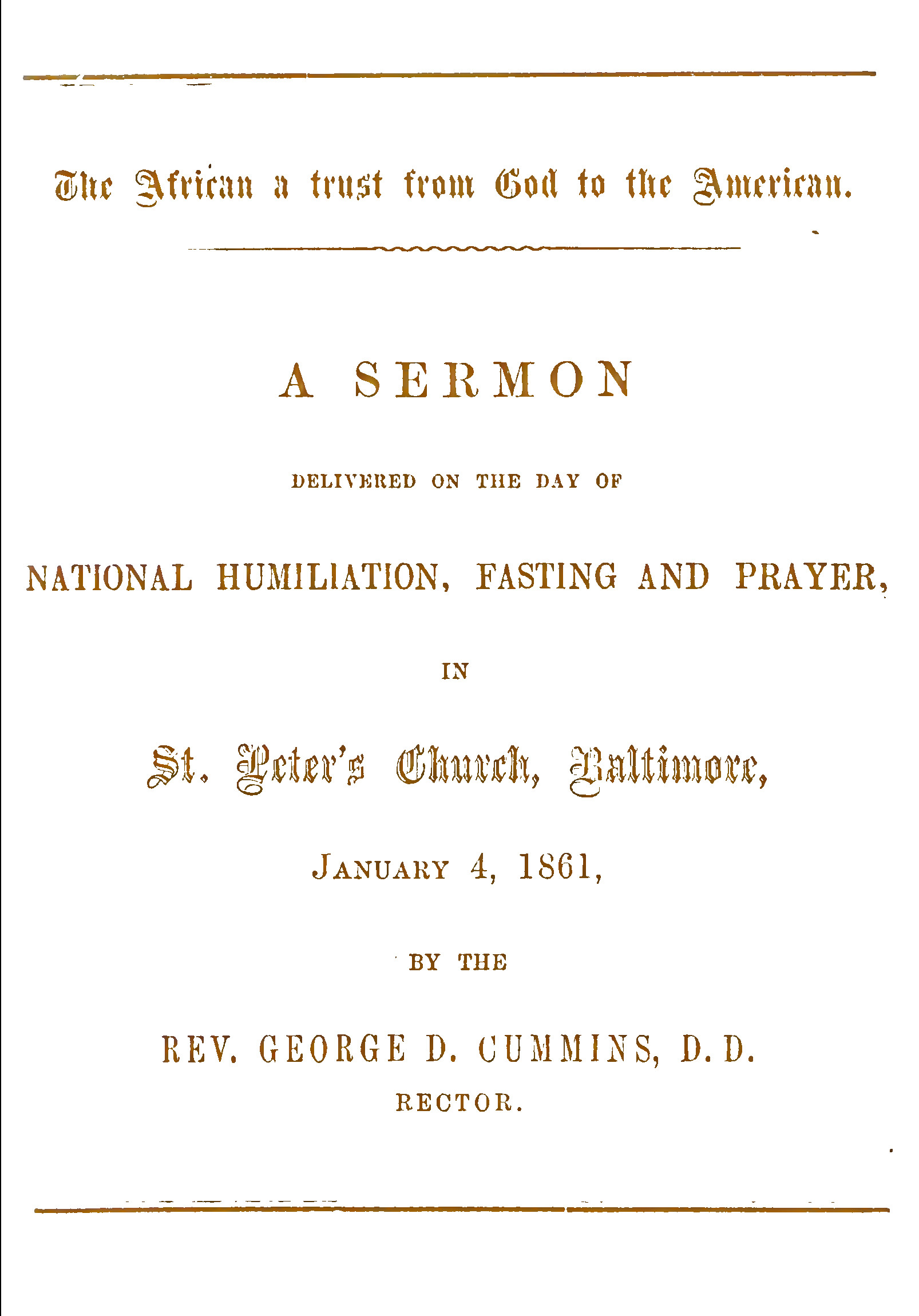
S
E R M O N
Jan. 4, 1861
Isaiah, LXV:8
|
Thus saith the Lord,
as the new wine is found in the cluster, and one saith, "Destroy it
not;
for a blessing is in it," so will I do for my servants' sakes, that I
may not destroy them all.
|
We are
assembled today in the House of God under
circumstances most solemn and affecting to every Christian heart, and
at a period of our national history fraught with imminent peril.
The
Chief Magistrate of a great nation has called its people to keep this
day holy by humiliation, fasting and prayer before God, that "His
omnipotent arm may save us from the awful effects of our own crimes and
follies."
If an inhabitant of some
other planet, or some
distant region
of the globe, could be present among us to-day for the first time, he
might ask, with unfeigned surprise, whence arises the need of this
solemnity, and what is the fearful peril which casts its dark shadow
before it over the land, like an eclipse of the sun at noonday?
Is
some foreign invader off the coasts of the land, with an overwhelming
force, threatening to burn your cities, desolate the country, and
subject it anew to the yoke of foreign tyranny? or is the noisome
pestilence abroad on the wings of the wind, making the whole land a
Baca, or vale of weeping over its ravages, and have ye met
to implore God to arrest the destroying angel? Nay, not these are
the
perils from which we seek relief by prayer and penitence; but an evil
which we would gladly exchange for the pestilence from God or invasion
from a foreign foe. Willingly would we now accept David's choice,
when
God gave to him liberty to elect one of three
fearful modes of Divine punishment, war, pestilence or famine, and say,
with the King of Israel, "Let us fall into the hand of the Lord,
and
not into the hands
of man."
No—we should
have to reply to the visitor
from some
other sphere—we are not trembling before the rapid approach of a
foreign foe, or pestilence, or famine; but this is our peril. The
people of this once happy and heaven-blessed land, are no longer an
united people in heart and brotherly love and generous sympathy; but,
though of one blood, of one race, of one language, of one literature,
of one religion, of one inheritance in the past, and possessing one
hope for the future, are so inflamed by sectional hatred and jealousy
as to be almost ready to plunge into all the horrors of civil and
internecine war; and having found no hope of deliverance from men,
from statesmen and men of policy, we now turn to God and ask Him to
turn the hearts of men to peace and conciliation, and to save us from
anarchy and ruin.
As an ambassador of Him whose birth was
hailed by angels as bringing "peace on earth and good will towards men"
and whose sublime title is "Prince of Peace," it is my part to-day, not
only in solemn prayers aud litanies, but from the pulpit, "to labor for
peace;" and a single word which might increase strife would be sadly
out of place at such a time and in such a service. Nor do I
design to
utter one such word. But there does seem to be a very special
appropriateness in occupying this hour, in taking a Christian view of
the great question which underlies the present crisis in our national
affairs, and of our conscientious obligations arising out of it.
It cannot be denied by
any that the existence of one
element in our national life, is that out of which has arisen all our
troubles; that the presence in our midst, of the African race,
numbering now one-sixth of the population, and for the most part in a
state of involuntary servitude, is the causa causans, which prejudice
and passion have fed upon until we awaken to see a yawning gulf of
destruction before us, from which only an Omnipotent Arm can save us.
Were it not for the intermixture of the two races, the Anglo-American
and the African, the presence of two civilizations, we can scarcely
imagine any serious cause of danger arising to threaten the perpetuity
of this nation, unless it should spring from the vices ever following
in the train of luxury and inflated prosperity. But this country
is
divided geographically between two sections, marked by two diverse and
yet not necessarily antagonistic social systems; fifteen of the
thirty-three States of the Confederacy being States where African
slavery is recognized and established by law.
Now, as to the. political
aspect of the slavery
question, I do not propose to-day to utter a word. It is the
glory of
the Protestant Episcopal Church in this
land that her ministers and her bishops, her Ecclesiastical Councils,
both State and National, have ever kept aloof from intermeddling with
this vexed question. Though existing in every State of the
Confederacy,
from Maine to Texas,
and from the Atlantic
to the Pacitic, her ministers, with scarce an exception, have deemed it
a subject not lying within their province to settle; and her
representatives from every section have met in General Convention for
seventy-five years, from the first session in New York in 1785, under the
patriarchal Bishop White, to the last in Richmond
in 1859; and in all these
not a word on this subject of national politics has been heard to
interrupt the flow of harmony and brotherly love. From this true
position of a teacher of religion and a guide in spiritual matters
alone,
it is not my purpose to depart. And if the Union
of these States
must be shattered by the agitation of this question, the future
historian of these times, shall not point to the Protestant Episcopal
Church, as having a part of the guilt lying at her door.
I shall, therefore, not
enter into a discussion
whether African slavery
be an advantage or a disadvantage to the well-being of a State—whether
certain conditions of climate and soil and culture render it
necessary or not—or whether the Constitution protects or prohibits it
in the national territories. Upon all these questions I have the
right
to form and hold an opinion, as a private citizen of the State and
Nation, but no right to bring them into this holy place and promulge
them to you.
But there is a moral and religious phase of the question of
African
slavery, as it exists among us, which is strictly within my province to
discuss. And it is this aspect of the subject which has reached
such a
complexion, that every conscientious Christian living where domestic
slavery exists, is called upon to answer in the light of his duty to
God for his position towards it, and his responsibilities arising out
of it.
For thirty years past a
persistent,
unwearied
and cumulative effort has been made to train the mind of one great
section of our country, and that the largest and strongest, to regard
slavery and slaveholding under all circumstances as a moral wrong, a
wrong against God and man, a violation of His will and word, and a
crime against humanity; and of course a sin which excludes all who
have a part in it from the kingdom of grace here, and the kingdom of
heaven hereafter. By the press, secular and religious, by books and
tracts without number, by the writings of novelists, by the teachings
of schools and colleges, by denunciations from the pulpit and lecture
room, by agitations in ecclesiastical conferences, synods and
assemblies; by all these agencies multiplied a thousand fold and
repeated
through the life-time of a generation, the result has been reached; and
a majority of the citizens of one great section of the country, where
slaveholding does not exist, have been brought to the conviction that
their brethren of the other section are guilty in this thing of a crime
against their fellow men and a sin against their God. This deep
feeling
has extended into other lands, where, rather we might say, it
had its origin, and Protestant England and Scotland,
and Catholie France
and Ireland,
have united in our condemnation.
Turning our gaze to
that section of our land visited with such severe condemnation,—what
do we behold? A moral waste? A barren wilderness as to its
religious
character? Communities given over to the powers of darkness, and
not a
ray of holy light to illumine the blackness? Nay, the Church of Christ,
existing in all its
integrity and fulness of spiritual life; powerful and vigorous
Churches; ministers of Christ in every quarter, and numbered by
thousands; communicants at the altars of the Churches, numbered by
hundreds of thousands; holy men and women of faith and prayer, proving
the reality of religion in lives consecrated to self-sacrifice and
self-denying Christian toil; a type of piety unsurpassed for excellence
and simplicity and purity in any age or nation of the globe;
benevolent agencies in active exercise for diffusing the gospel
throughout the world and among the spiritually-destitute at home;
missionary societies sending forth evangelists to India and China and Burmah and Africa;
philanthropic societies ministering to the poor, the sick and the
prisoner; Howard associations, not less distinguished for heroic
daring amidst the pestilence than the famous Florentine Brothers of
Mercy; the Gospel preached as faithfully as ever proclaimed by St.
Paul,
by Christ's true and faithful servants;
souls daily converted and added to the Church; revivals of religion,
the fruit of the Holy Spirit making the Gospel, the power of God, unto
salvation; learned Divines devoting their lives to the study of the
sacred Scriptures; public teachers of morals in schools and colleges;
seminaries for training youth for the Gospel ministry—in a word,
God's people, acknowledging His word as their guide, claiming His
Holy Spirit as their teacher, owning Christ to be their model and great
Exemplar.
I can speak more especially
for the Church
of which I am an humble minister; that in this section where domestic
slavery exists, there are well-nigh fifty thousand communicants,
served by nearly seven hundred clergymen and presided over by sixteen
bishops, many of whom would have adorned the Church of Christ
in any age. And if not for all these, yet surely I may not
presumptuously claim to speak to-day for the ten thousand communicants
of the Protestant Episcopal Church in this State of Maryland.
True,
indeed, not all of these are themselves holders of slaves, but all are
included in a like condemnation, if it be a just one; since to live
surrounded by a great and flagrant moral wrong, and not to be a witness
against it and to labor for its removal, is to be a sharer in its
guilt.
What then, is the attitude
of the
conscientious Christians of the South towards this great question?
I
venture to express the opinion that the time has come to let all
Christendom know what that posture is—what answer they have to make
at the bar of God when charged with upholding a system of
iniquity. I
would speak then, to-day, in behalf of the Christian whose lot has been
cast amidst a social system where slavery is one of its marked
features. I speak not only for the Christian slaveholder, for I
am not
one of the number, but also for that large class who have been born and
reared under its influence.
Let
me state the case of
one of these: He is born into life in a Southern clime and in a
Southern home, and almost the first faces with which he becomes
familiar are the dark faces of another race than the one which gave him
birth. The first guardian and nurse of his infancy is an African;
the
earliest playmates of his childhood are the children of this race; he
grows to manhood surrounded by their faces now become familiar, and
learns to regard them as a part of the household of his parents.
Now he
comprehends their position, that they are in a state of servitude to
the superior race; that they are the descendants of heathens and
savages who were brought from their distant homes in Africa, perhaps an
hundred years ago. Soon he finds that he must take upon him the
personal responsibility of being the master of such, and while
receiving the benefit of their labor to provide for their well-being,
and the well-being of their children. Seeking honestly to
comprehend
all the duties and responsibilities of his relation, he sets himself to
ascertain all the truth concerning it. And the very first step he
reaches is one too patent to be overlooked by any, and that is this:
I. That he is not responsible for the
presence of this race around him, nor for its condition of servitude—nor
was his father any more
responsible for it; both received it as an inheritance, whether for
good or evil: still an inheritance he cannot decline, a burden he
cannot
shrink from. He tries to trace back this institution to its
source,
but finds it coeval with the existence of the nation, and that at the
time of the formation of the Confederacy, slavery existed in all but
one of the thirteen States of the Union.
Thus he finds it to have been a bequest from the mother country, Great
Britain; and looking into its history there, he traces its existence
to the very earliest periods of Saxon history; and still extending and
widening his view, he perceives it pervading all the great historic
nations, Italy,
Greece,
the Eastern kingdoms, and the chosen people of God, even up to the
time of the patriarchs. Still, this antiquity of slavery would
not of
itself satisfy his mind concerning his duty towards it, nor of itself
justify it, for error and wrong may be hoary with age, as well as truth
and right.
II. Another step then is
needed,—to
ascertain God's will concerning it, and a Christian's duty towards
the race in bondage, in the light of the teachings of the Word of
God.
The entire argument concerning the teaching of the Bible as to the
moral and religious phase of slavery is one which might fill a volume
far better than a page of a sermon; and we must be content only to
mention its leading points.
1. The first of these is
the attitude which our Blessed Lord maintained during His earthly
ministry towards slavery and slaveholders. When our Saviour
appeared on
the earth, domestic servitude existed, by law, throughout the entire
Roman Empire, from Britain
to Parthia,
and no part of the immense dominion of the Caesars was exempt from
it.
Slaves were acquired by
war, by commerce, by inheritance, and even
free-born Romans could be reduced to slavery, under certain
circumstances, by the operation of law. In the population of Italy,
under Augustus, there were three slaves to every free man. The
Romans,
who were masters of Judea,
transported their
slaves thither, as an indispensable part of their domestic
arrangement. The Divine Redeemer, on His missions of mercy, could
not
fail to be brought into contact with the system. And so, indeed
it
proved, for one of His first and most striking miracles of mercy was
wrought upon a slave of a Roman centurion, and in answer to the
prayer of the master; and it was of this Roman slaveholder that Jesus
said, "I have not found so great faith, no, not in Israel."
The silence of Jesus with reference to the moral aspect of slavery is
that which is most significant to a Christian man in determining his
duty towards it. He did not shrink from the most severe
denunciations
of the flagrant and crying
sins of the men of his time for fear of personal injury
to himself. Let
any one who would be convinced of this read the 23d
chapter of St. Matthew's gospel, and hear the stern and overwhelming
rebukes which fell from the lips of Christ against the prevailing sins
of the people. Hypocrisy, envy, malice, uncleanness, extortion,
oppressing the poor, blood-guiltiness, all are charged home upon the
people, until the storm of his indignation falls in one thunderbolt
of—"Ye serpents, ye generation of vipers, how can ye escape the
damnation of hell?" [St. Matthew, xxiii, 13--33] Yet in all the list of
woes, there is none pronounced against slaveholding or the slaveholder.
2. The next point in the
Scripture
argument is the attitude of the apostles of Christ towards the same
system. These inspired and holy men went forth at the command of
their
master to preach the gospel and lay the foundations of His
church. One
of them especially, St. Paul,
traveled through a great portion of the Roman
Empire, every
where coming into direct and close contact with slavery. Yet in
all his
preaching and in all his epistles to the churches planted by him,
there is not to be found one testimony against the wrong of slavery;
not one precept that it is the duty of masters to emancipate their
slaves, not a word of the sinfulness of slavery. All other
offences of
man against his fellow-man are condemned unsparingly; but this is
strangely omitted, if it be the deadly sin it is now proclaimed by
some.
But look at the conduct and
teachings of St. Paul
more in
detail. In the city of Athens,
where he preached to the philosophers on Mars Hill, and reasoned with
the Stoics and Epicureans in the marketplace, three-fourths of the
population were slaves: yet not a word falls from his lips concerning
this chief feature of Athenian society in all that memorable
discourse. At Corinth,
which was for so long a time the chief slave mart of Greece, St. Paul
resided for eighteen months in the exercise of his ministry, and
founded a church embracing both converted masters and slaves. To
this
church he writes a letter full of inspired counsels, and among them
is this: "Let every man abide
in the same calling wherein he was called," that
is, "called" into Christ's kingdom. "Art thou called being a
servant? —
(a slave) — care not for it, but if thou mayest be made free use it
rather"—that is, if thy freedom is offered thee, accept it and enjoy
it. "Brethren, let every man, wherein he is called, abide therein
with
God." [I Cor., vii, 20--24] At Ephesus, also, where slaves were very
numerous, St.
Paul dwelt two whole years "preaching the things
concerning the kingdom of God." Here, too, these bondmen were
brought
into the liberty of the sons of God and enrolled in His church.
And
writing to them afterward, the apostle says, "servants? (slaves) be
obedient to them that are your masters according to the flesh, with
fear and trembling, in singleness of heart, as unto Christ; not with
eye-service as men-pleasers, but as the servants of Christ, doing the
will of God from the heart; with good-will doing service, as to the
Lord and not unto men; knowing that whatsoever good thing any man
doeth, the same shall he receive of the Lord whether he be bond or
free." [Eph. vi, 5--9] Here slaves are charged to perform their duties
of obedience
and single-minded service "as unto Christ," as accountable unto God
for fidelity to their masters.
The same
heaven-taught man, writing to Timothy concerning his duties towards the
churches over which the Holy Ghost had made him overseer, thus defines
the duties of slaves: "Let as many servants as are under the yoke
count their own masters worthy of all honor that
the name of God and His doctrine be
not blasphemed. And they that have believing masters, let them
not
despise them because they are brethren ; but rather do them service
because they are faithful and beloved, partakers of the benefit." [I
Tim., vi, 1--2] Then
follows an injunction to Timothy to withdraw himself from persons who
taught a contrary doctrine. Of a like import is his teaching to
Titus,
the bishop of Crete: "Exhort
servants (slaves) to be obedient unto their own masters, and to please
them in all things; not answering again; not purloining, but shewing
all good fidelity, that they may adorn the doctrine of God our Saviour
in all things.'' [Titus, ii, 4--10] "Crete
was full of slaves from the earliest times to which history carries
us."
As to the case of Onesimus,
I prefer to quote
the language of the late Prof. Edwards, of the Andover Theological Seminary, one of
the first Biblical scholars of this century and one of the holiest men
who have ever adorned the cause of Sacred literature. He says,
"Onesimus was the slave of Philemon, a Colossian, who had been made a
Christian through the ministry of Paul. He absconded from his
master
for a reason which is not fully explained. In the course of his
flight,
he met with the apostle at Rome,
by whom he was converted, and ultimately recommended to the favor of
his old master. St. Paul would, under any circumstances, have had
no
choice, but to send Onesimus to his master; the detention of a
fugitive slave was considered the same ofience as theft, and would, no
doubt, incur liability to prosecution for damages.'' [Biblical
Repository, Oct. 1835]
This, then, is the argument
from the New
Testament concerning slavery as a moral wrong. Every allusion to
it by
inspired apostles recognizes it as a part of the social system
established by law, and enjoins fidelity in the discharge of the duties
arising out of it, and no where, in a single instance, is it declared
to be of itself sinful. But there is an indirect sanction of the
system, perhaps still more marked. The inspired writers of the
New
Testament do condemn the abuses
of the relation between master and
slave, do denounce the evils
which were found existing along with it in
their day. These abuses
or evils were indeed enormous
among the Greeks
and Romans. In both nations the life of the slave was absolutely
in the
power of the master. At Athens
oftentimes cruel and barbarous punishments were inflicted upon them,
sometimes the torture of the wheel. The Romans punished gross
offences
among them by crucifixion. In Sparta they
were liable to the horrible cryptia
or ambuscade, when the Spartan
youth were encouraged by their governors to fall upon the Helots at
night, or in unfrequented places, and murder them, that these youths
might be better fitted for the stern and cruel scenes of war. It
is an
insult to Christianity, whose spirit is one of infinite mercy and love,
to ask the question whether it approved
or even tolerated such
evils?
The soul of every Christian revolts against all cruelty, all
injustice, all oppression in every relation of life. Jesus did
condemn all the evils which existed along with slavery, when he said,
"Blessed are the merciful.'' "Whatsoever ye would that men should do
unto you, do ye even so to them,"
The golden rule, which bade
the
slaveholder treat the bondman with the same justice and kindness with
which he would wish to be treated if their relations were reversed.
And the apostles of Jesus
likewise did not hesitate to warn Christian
masters against these evils, and to guard them from these abuses.
"And
ye masters!" says St. Paul
to the Ephesians, "forbear threatening, knowing that your master also
is in heaven; neither is there respect of persons with Him."
Ephesians, v., 9. To the Colossians he writes, "masters! give unto your
servants (slaves) that which is just and equal, knowing that ye also
have a master in heaven;" Col.
iv. 1. "That this injunction cannot mean the legal enfranchisement
of the slave is clear," says Prof Edwards, "for why, in that case, were
any directions given to the slaves, if the relation was not to
continue." [Biblical
Repository, Oct. 1835]
And the same apostle denounces "men-stealers," or those who
unlawfully seduced freemen to slavery as on a par with murderers.
[I Timothy, i, 10]
The argument to be drawn
from these facts is, that inasmuch as the
apostles of our Lord did condemn the abuses which were connected with
slavery, and did prescribe the duties of both masters and slaves; that
they did indirectly recognize the system as not forbidden by the word
or will of God, and not of itself involving moral wrong, and their
practice everywhere was in keeping with this view; for in every place
where the Church was planted, slaveholders were admitted
into its fellowship without hesitation. Philemon, of
Colosse, was but one of the pious slave-holders who was a "brother
dearly beloved and fellow laborer," [Philemon, i, 1] to St.
Paul.
That the Gospel of
Christ did much to ameliorate the condition of the slave, and remove
the evils of slavery, we joyfully acknowledge. It proclaimed with
trumpet tongue, charity, forgiveness, kindness and love. It
elevated
the worth of the soul of the slave. It banished and extirpated
the
gladiatorial combats which were always among the slaves trained for
this purpose. It taught the master that the slave had a common
share
with him in sin and in redemption; that he was the purchase of a
common Redeemer's blood; and that in
Christ there was neither bond nor
free. But it never, directly or indirectly, by precept or
practice,
taught that slaveholding was a sin against God and a crime against
man.
Nor did slavery cease to
exist and prevail in
the primitive church of the first three centuries—the days of its
very highest purity, and when refined by the fires of martyrdom.
Ignatius, the bishop of Antioch,
who was torn to pieces by the lions in the Coliseum at Rome,
writing to Polycarp, bishop of Smyrna, who, for his confession of
Christ, was burned at the stake, says—"Overlook not the men and maid
servants, neither let them be puffed up; but rather let them be more
subject to the glory of God, that they may obtain from Him a better
freedom. Let them not desire
to be set free at the public cost that they be not slaves to their own
lusts." [Epistle of Ignatius, chap. 2] But the early
Church pursued the same course towards the
institution as the apostles did. It did not denounce it, nor seek
violently to overturn it. It recognized it as established by law
and
permitted by the Providence of God, but admitted freely masters and
slaves to all its privileges and blessings—while at the same time it
sought to mitigate the evils existing along with it. Slaves,
holding
the true faith, were taken into the service of the Church, and ordained
to the ministry by the consent of their masters, without being
emancipated. Christian Emperors enacted laws to restrain the
power of
inhuman masters. But the primitive Church rose, flourished and
triumphed over the Empire and left slavery to exist for centuries
afterwards.
By the light of this survey
of
Scripture, and the history of the early Church, a Christian man whose
lot is cast amidst slavery in this age and nation, is enabled to
ascertain his duty towards it—and that is:
III, To regard the African race in bondage (and
in freedom too) as a solemn
trust committed to this people from God, and that He has given to us
the great mission of working out His purposes of mercy and love towards
them. The Anglo-American, the tutelar guardian of the
African—this
is the lofty view to which we now rise. It is a study of intense
interest to trace the workings of God's Providence
in the mode He has chosen to effect His purposes concerning these
children of Ham. He has linked together,
by a counsel of
infinite wisdom, the destiny of two races, more diverse from each other
than any two upon the globe. By the silver thread of His
providence the
weakest race on the earth has been joined to the strongest, the oldest
to the newest, the most repulsive barbarism to the highest
civilization, the darkest superstition to the brightest and purest
Christianity. The feeble African parasite has found a prop on which
to climb on the noble oak of our Western land.
Other
races have at different periods of history been brought into close and
intimate relations with the African race, as the Roman and the
Castilian, but not to these has God entrusted this great work. To
the
Anglo-Saxon and the American has He reserved the high honor. See
already how He is leading them on in the accomplishing of this work.
1. In abolishing the
slave-trade, the fruitful source of every evil on
the Continent of Africa.
2. In stimulating
explorations throughout the land heretofore a terra incognita, thus
throwing open to Christianity and civilization a vast area peopled by
savage and degraded tribes.
3. Next, by the
missionary enterprise which has already translated the Bible into five
dialects and preached the Gospel to five millions of its people.
4. Above all, God has
brought these people to our doors and placed them
in our homes, and said to us by His Providence, "take this child and
nurse it for me, and I will give thee wages." It is a sublime
trust, a
stupendous work, worthy of the genius of this Christian nation, to
train, to discipline a race, to prepare them to work out the destiny
of a continent of one hundred and fifty millions of the same
race. We
believe this to be the design of God, in the presence and condition of
the African in this land. And it is for us to decide whether we
will
fulfil this high mission, or fail ignominiously under it. We
cannot
decline the trust; it is ours by inheritance, and not by our
seeking.
We cannot escape from its responsibilities, if we would. But how
shall we best fulfil that trust? This question involves and
determines
our duty towards the Africans in servitude. How shall we prove
ourselves their truest friends—their best guardians? How
discharge
our duty towards them in the light of our duty to the Master whom we
serve? Will it be by seeking hastily and violently to
change their
condition, and bid them go forth from under our guardianship? As
well
might we turn from our doors our children of tender years and send them
forth, helpless, into the world, exposed to every evil. It has
been
well and truthfully said, that "it is not too much to say that if the
South should, at this moment, surrender every slave, the wisdom of the
entire world, united in solemn council, could not solve the question of
their disposal." But we may add, that the Providence of God will
solve
it, in His own time, if we do not rashly thwart His plans, by our
short-sighted schemes. It may, indeed, be a long time before He
develops all His purposes towards the African race, and like ancient Israel,
He may prolong the time of their discipline. But in all His
sublime
movements, there is ever the same slow and stately movement,
ever the
absence of all haste. It required four thousand years to prepare the
world for the Advent of Christianity; and it may require four thousand
more to extend its triumphs over the whole earth. This is,
indeed, a
feature of the Divine working most opposed to human schemes of
impatient haste. Many have lost all faith, in the final triumph
of
truth and right, because of the slow progress made in a generation or a
century. Calvin's motto upon his signet-ring was the Psalmist's
cry, Quousque Domine? "How
long, Lord?" But we can well be patient and
wait on Him, with whom a "thousand years are as one day."
But the chief
part of the question as to our duty towards the subject-race among us,
is not yet answered. What would God have us do for and towards
them?
I reply:
1. To acknowledge him as of one blood with
ourselves, a sharer in a common humanity, a partaker of our hopes and
fears.
2. To labor for his salvation, for his
conversion from a savage and a heathen to a servant of Christ; to make
him one with us in the heritage of the Church of the Redeemer.
Who can
suppose that if the Apostles of our Lord were now among us and in our
lot, that they would desire to do more? St. Paul did not at Corinth
and Colosse, nor did Timothy at Ephesus, nor did Titus at Crete.
This great work, the
Christians of the South are now zealously and earnestly striving to
perform. Throughout the fifteen slaveholding States of this
Union,
there are men and women of God who feel the solemn duty resting upon
them to labor for the conversion of the slave. Every Christian
denomination of the South is engaged in this work, each seeking to
surpass the other in holy zeal. In some of the Churches, the
Africans
professing the faith of Christ are numbered by tens and even hundreds
of thousands. Sunday Schools for their instruction in the
doctrines
of the Gospel, abound in every part of the Southern country, and the
Gospel is preached to as many of the slaves, in proportion to their
numhers, as it is to any people of any section of this land. It
was
lately proved by a most careful statistical scrutiny, that in the chief
commercial metropolis of this country, out of a population of 800,000
people, only 200,000 were provided with opportunities for having the
Gospel preached, while 600,000 could not find a place in any House of
God, if they so desired. Can this be said of the religious
privileges
of the slaves of the South? Far, very far from it; the number of
these
is exceedingly small who do not regularly hear the Gospel, or have it
within their power to hear it.
I
can speak with certainty of our own
branch of Christ's Church; and of that I can testify to-day, that in
all our large Southern Dioceses, the Church is successfully at work
in the conversion of the African. Says the Right Rev. Bishop
Green, of Mississippi,
in
his last report to the General Convention of our Church: "Never before
have so many of the slave population been brought within the bosom of
the Church in this diocese. Never before has this field
presented such an inviting aspect to the laborer in the spiritual
harvest. On every hand is observed the increasing desire on the
part of
masters to give unto their servants the blessings of the Gospel and the
Church; and could we only comply with their pressing invitations to
preach the Word of Life to our 'Africa
at home,' the time would soon come when we should behold thousands of Ethiopia's
sons stretching
out their hands unto God." [Journal of Convention of
1859---Mississippi]
Says the truly
apostolic Bishop Davis, of South Carolina,
"about fifty chapels for the benefit of negroes on plantations, are
now in use for the worship of God and the religious instruction of
slaves. Many planters employ missionaries or catechists for this
purpose; many more would do so, if it were possible to procure
them.
In one parish, there are thirteen chapels for negroes supplied with
regular services. The number of negroes attending the services of
the
Church is very large and increasing annually." [Journal of Convention of 1859---South
Carolina] Of Virginia, I can
speak from a
residence of nearly eight years as a minister in two of her principal
cities. I believe facts would bear me out in the statement of my
belief, that in the State of Virginia,
the number of colored church members in all the denominations is equal
to, if not greater than that of the whites. All the Churches of
that
commonwealth are alive to their duty toward the slave. All the
pious
people of God feel most deeply their personal share in this obligation,
and seek the means
of discharging it.
The wealthy farmer builds for the slaves their own chapel, and
provides them a spiritual teacher. Not a Church edifice is
erected
in town or country, but provision is made within its walls for the
people of color. Flourishing Churches of colored people alone
exist in
every city and the larger towns. Sunday schools for adults and
children are under the care of all the Churches. In thousands of
homes, on every Sunday, masters and mistresses assemble a portion of
their servants for religious instruction. And this very
concern, for the religious welfare of the slave, tends to develop the
finest graces of the Christian character. Nothing so powerfully
nourishes the Christian graces of the parent, as the responsibilities
of his relation to the children whom God has given him. To a
Christian slaveholder, his slaves occupy to him a relation scarcely
less inferior to that of children; they form part of his household,
and for their temporal and eternal welfare he feels himself responsible
to God. How profound is this feeling of responsibility, I can
attest
from a personal residence among the pious masters of Virginia.
I "speak that which I know and testify that which 1 have seen."
It
was my lot to minister at the altar of a Church where, along with
three hundred whites, fifty slaves knelt by them to receive the
sacrament of the Lord's supper. I have seen the master standing
at the
chancel of the Church to act as sponsor in baptism for a faithful
slave who came forward to receive the sacred rite. I have seen
Christian women of the highest refinement and social position, sitting
down on every Lord's day in the midst of the classes of a
Sunday
School of slaves, to instruct them in the knowledge of salvation.
I
have known the slave girl in consumption to be taken into the chamber
of her mistress and nursed with a care equal to a mother's tenderness,
and the passage to the grave illumined by the light of Christian
sympathy and love. And I have seen a congregation of three
thousand
slaves presided over by their regular pastor, the President of a
College, at the close of each sermon responding to the catechetical
instruction concerning the truths preached.
But it
will be said that according to the example of the apostles and the
early Christians, our whole duty towards slavery is not fulfilled until
we do our part to correct its abuses and remove the evils attendant
upon it—and we freely admit this. It is our part and duty following
in the steps of the apostles, to tell both masters and servants of
their mutual duties, and to warn them against abusing the relation in
which they stand to each other—to say to the servant "obey your masters
in singleness of heart as unto the Lord !"—to say to the
masters, "give unto your servants that which is just and equal."
And
we firmly and earnestly believe that there is not an evil connected
with slavery as it now exists in the Southern States, which in due time
would not be corrected and removed by the force of Christian sentiment,
enlightened by the Holy Spirit and guided by the Word of God. There is
power enough in the Christianity of the South to grapple with and
solve all the difficulties of this great question, if
left unhindered hy interference from without.
A word to the Christian
people of the State of Maryland
must be added to complete the survey of our duty in the position where
God's Providence
has placed us. There is much in your position towards the African
race
which may comfort you amidst the perils of the present crisis.
You have
not been wanting in the effort to discharge your trust, and to perform
your duty towards this people. The slaves of Maryland
share equally with you all the inheritance of the Gospel and the Church of Christ.
Eighty thousand free people of color live within your borders, in
thousands of happy homes, unoppressed by any heavy burden, with
schools,
churches, and ministers of their own, with "none to molest them or make
them afraid."
And last and not least, you have planted from among
these a Christian colony on the shores of Africa,
now part of a Republic, a brilliant gem on the dark forehead of that
continent, and the centre of light and knowledge and religion to
millions of its heathen and savage tribes.
Shall
all
this work continue? Shall
we go forward in the strength of God,
fulfilling the mission He has assigned to us toward the African, and
working out God's blessed purpose towards him through our agency?
Shall
we bear him on with us to our and his final triumph? or shall we
perish with him? or leave him to perish? There is, to my mind,
but
one thing that will determine these questions—the preservation OR
THE DESTRUCTION OF THE UNION OF THIS
CONFEDERACY. May God in
His infinite mercy preserve it for us. for our children and our
children's children, for generations yet unborn. "Let thy work
appear
unto thy servants, and thy glory unto their children. And let the
beauty of the Lord our God be upon us; and establish thou the work of
our hands upon us; yea, the work of our hands establish thou it."
|